
Explain Floral Art Trends: What Designers Need in 2026
Floral art in 2026 is not about pretty. It’s about intention, atmosphere, and lasting impact. If you’re an artist or designer trying to explain floral art trends to clients or simply looking to sharpen your own creative direction, the shift happening right now is significant. Today’s floral artistry has moved from decorative filler to a full design language, where texture, permanence, and emotional resonance matter as much as the blooms themselves. This article breaks down the six forces reshaping floral design so you can apply them with confidence.
Key takeaways
| Point | Details |
|---|---|
| Biophilic design leads | Floral art now prioritizes consistent botanical presence throughout spaces, not occasional decoration. |
| Preserved botanicals go luxury | Dried and preserved flowers are sculptural statement pieces, not rustic afterthoughts. |
| Color tells a story | Pantone’s Mocha Mousse and warm earth tones anchor 2026’s floral color palette. |
| Restraint and scale coexist | Mono-floral minimalism and architectural installations are both dominant and valid approaches. |
| Texture is the new focal point | Layering velvet roses, moss, and grasses creates tactile depth that color alone cannot achieve. |
How to explain floral art trends in 2026
The clearest way to understand what’s happening in floral design right now is this: flowers are no longer decorations. They are design decisions. Biophilic design is the dominant interior movement of 2026, and floral artistry sits at its center. This means botanical elements aren’t placed occasionally for visual softness. They’re woven into the architecture of a space with the same deliberateness as furniture or lighting.
For artists and designers, this reframing is enormous. A single preserved stem in a gallery setting carries as much weight as a painting. A moss wall installation in a lobby functions as a permanent art feature. Understanding current floral design trends means accepting that the field has expanded well beyond flower arrangements and into spatial storytelling.
Here’s what biophilic floral integration looks like across different environments:
- Residential spaces: Living walls, shelf-integrated dried botanicals, and preserved moss panels that bring natural texture to minimalist interiors
- Commercial and hospitality: Hanging botanical clouds above reception areas, oversized preserved floral columns at entrances, and statement installations that replace traditional wall art
- Event design: Ceremony arches and tablescapes built as complete atmospheric environments, not as background decoration
- Studio and gallery settings: Single large-scale botanical sculptures that anchor the entire visual field of a room
Pro Tip: When advising clients on biophilic floral art, don’t pitch it as decoration. Pitch it as an environmental design layer that changes how a space feels to inhabit. That shift in framing converts skeptics quickly.
Preserved botanicals as sculptural art
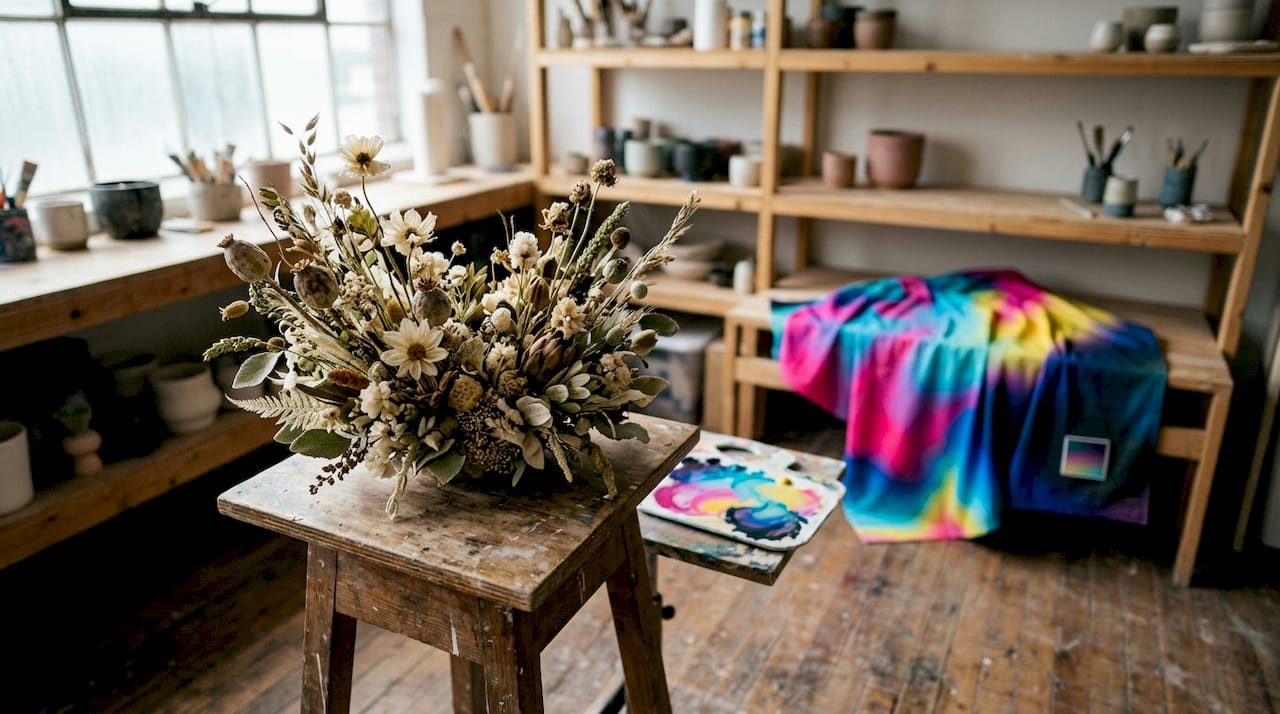
The upgrade of dried and preserved botanicals from rustic filler to gallery-worthy art is one of the most important shifts in current floral design trends. Preserved hydrangeas and roses are now used as sculptural centerpieces in minimalist settings, chosen for their shape and surface quality as much as their color.
What separates elevated preserved botanical work from the overstuffed farmhouse look most designers are trying to avoid? It comes down to placement philosophy. Effective preserved botanical work relies on minimalist, sculptural placement that emphasizes shape and material dialogue rather than filling volume.
Here’s a practical framework for working with preserved botanicals at a high level:
- Start with the vessel. The container is part of the composition. A narrow matte ceramic with a single preserved peony branch reads as sculpture. The same branch in a mason jar reads as craft.
- Edit ruthlessly. One well-chosen preserved stem often communicates more than a cluster. Ask yourself what you can remove, not what you can add.
- Layer materials, not just flowers. Pair preserved roses with dried seed pods, bleached branches, or preserved lichen to create material contrast without visual clutter.
- Treat negative space as active. The empty area around a preserved piece is not wasted space. It gives the viewer’s eye a place to rest and amplifies the piece’s presence.
- Consider scale relative to the setting. A preserved botanical meant for a large wall niche needs mass. A desk piece needs restraint. Neither approach is wrong, but confusing their scales produces weak results.
Pro Tip: Consumers now prefer durable preserved flowers over short-lived fresh arrangements. Lead with longevity when positioning preserved botanical work. “This piece lasts for years, not days” closes more conversations than any styling detail.
The 2026 floral color palette
Color in 2026 floral artistry is not about brightness for its own sake. It’s about mood architecture. Mocha Mousse, Pantone’s 2026 color of the year, signals a decisive move toward warm earth palettes. Warm browns with cocoa and caramel undertones are replacing the cooler grays and whites that defined the previous half-decade of interior design.
For floral artists, this creates a specific and exciting color language to work within:
- Mocha and warm earth tones: Dried pampas in champagne, preserved roses in terracotta and rust, and raw cotton branches sit perfectly within this palette and feel current without being trendy for their own sake.
- Green as a lead color: Green shifts from filler to palette core in 2026. Deep hunter greens, sage, and eucalyptus tones are used as primary color statements, not supporting cast. A composition built entirely on green tones with varied texture is now a complete design, not an unfinished one.
- Deep reds used with restraint: Wine, oxblood, and burgundy reds appear in focused applications, a single dramatic bloom or a tight cluster, rather than throughout an arrangement. The restraint is what gives them power.
- Butter yellow for seasonal freshness: Light, warm yellows bring optimism to spring and summer work without veering into the oversaturated tones of years past.
What ties all of these choices together is the understanding that color in floral art creates emotional weather in a room. Warm earth tones say grounded and intimate. Deep greens say alive and considered. Butter yellow says open and forward-looking. Choosing a palette is really choosing the feeling you want a space to carry.
Minimalism vs. architectural scale
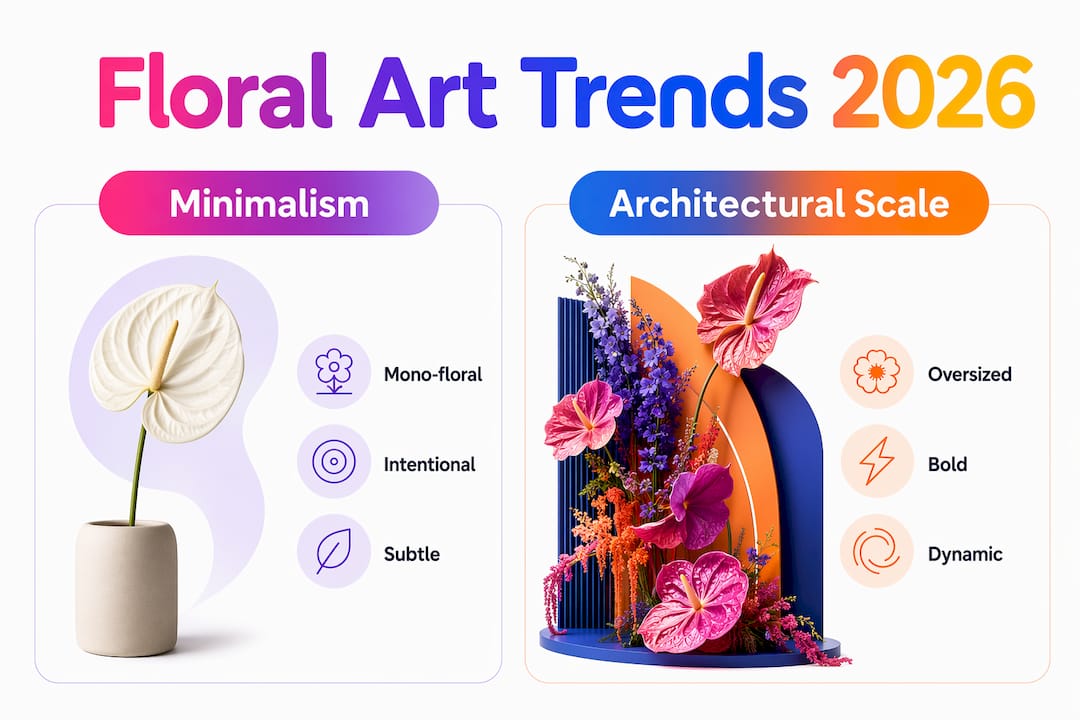
These two directions feel opposite but they are both expressions of the same core value: intention over abundance. Understanding artistic floral displays in 2026 means knowing when each approach is the right tool.
| Approach | Best For | Key Techniques | What to Avoid |
|---|---|---|---|
| Mono-floral minimalism | Residential interiors, gallery settings, intimate events | Single species, texture layering, negative space | Flatness from lack of form variation |
| Architectural scale | Hotels, large events, commercial spaces, statement walls | Oversized installations, hanging clouds, moss walls | Overwrought or cluttered compositions that lose focal point |
Mono-floral minimalism is inspired by Japanese Ikebana, the centuries-old practice of treating a single bloom or arrangement as a complete design statement. The modern version applies this restraint to preserved flowers so the composition holds its integrity over time. The real challenge with this style is avoiding flatness. A single-species arrangement can look empty rather than intentional if there’s no variation in form. The fix is layering textures and shapes like seed heads, grasses, and branches within the single-species constraint.
Architectural scale is the other end of the spectrum. Oversized floral walls, hanging botanical clouds, and moss installations now function as permanent or semi-permanent design features in upscale environments. These pieces are not event backdrops. They are the room’s defining visual element, and they demand the same conceptual rigor as any commissioned artwork. Florists and designers who understand placement, movement, and texture create these installations with purpose rather than volume. The goal is impact, not accumulation.
When advising on which approach to choose, ask one question: does the space call for quiet or declaration? That answer drives everything else.
Texture layering and botanical permanence
Texture is the defining sensory focus of 2026 floral artistry, and it’s one of the most underutilized tools in the field. Combining velvet roses, hydrangeas, grasses, and preserved moss creates surface experiences that reward close viewing and change character depending on light and angle. Color gets noticed first. Texture is what makes someone reach out and touch, and then remember.
Here’s how to build texture-rich botanical compositions that hold up over time:
- Contrast surface qualities. Pair smooth against rough: a polished rose petal against preserved gray lichen, or a silky ribbon grass against coarse dried seed pods.
- Vary heights and density. Cluster dense materials at the base and allow airier elements, dried grasses or hanging amaranthus, to extend the composition upward. This prevents the flat-top effect that kills visual interest.
- Introduce structural elements. Bleached branches, sculptural twigs, and woody stems give the eye a framework to follow through the composition.
- Use preserved moss as a surface material. Sheet moss and reindeer moss work as both base layers and focal elements. They add color, texture, and a deeply organic quality that fresh flowers alone cannot replicate.
The permanence dimension connects directly to sustainability and luxury merging in floral art. Clients and collectors increasingly choose durable preserved installations over ephemeral fresh-flower displays because they want art that lives in their space, not a three-day experience. This creates a genuine opportunity for floral artists to position their work as long-term investments rather than temporary services.
Pro Tip: When presenting a texture-layered preserved piece to a client, photograph it under both warm artificial light and natural daylight. The way the piece transforms between conditions is often the single most persuasive selling point.
My take on where floral artistry is heading
I’ve spent a lot of time looking at how creative fields absorb trend cycles, and what I find genuinely interesting about 2026 floral art is that the trends are converging rather than fragmenting. Minimalism and monumental scale. Sustainability and luxury. Permanence and organic material. These pairings would have seemed contradictory five years ago.
What that tells me is that the field is maturing. The best floral artists I see working today are not chasing aesthetics. They are building a point of view. And a clear point of view, expressed through material choice, placement, and color, is what separates work that earns wall space from work that fills it.
My honest advice: stop asking what’s trending and start asking what you believe about space, nature, and longevity. The designers getting the most interesting commissions in 2026 are the ones who can articulate why they made every choice, not just what the choices look like. Wedding clients now demand intention and personality in their floral design, and that demand is moving into every other context too.
Floral art is becoming fine art. That’s not hyperbole. It’s where the serious practitioners are already working.
— Shlomo
Bring 2026 floral art into your creative space
If the trends covered here have shifted how you see floral art, the next step is applying that visual language to your own environment. You don’t need a moss wall installation to bring the feeling of 2026 floral artistry into your space. Well-chosen wall art that echoes botanical textures, warm earth palettes, and organic forms can do the same conceptual work.
Colormelt’s wall art collection includes floral and nature-inspired prints built around exactly the color stories and textural depth this article describes. The Weave Design framed pieces carry the kind of layered visual complexity that mirrors 2026’s texture-forward aesthetic, and the colorful wall decor options work beautifully alongside both minimalist and statement botanical arrangements. If you’re pulling together a space that reflects current design thinking, these pieces are a natural fit. Colormelt uses fade-resistant printing so the colors stay as considered as the day you hang them. Explore the full range and find what belongs in your space.
FAQ
What does it mean to explain floral art trends in 2026?
Explaining floral art trends in 2026 means describing the shift from decorative arrangements to intentional, conceptual botanical design. Key directions include biophilic integration, preserved botanicals as sculpture, warm earth palettes, and architectural-scale installations.
What is mono-floral minimalism?
Mono-floral minimalism is a style inspired by Japanese Ikebana that uses a single bloom or species as a complete design statement, relying on texture variation and negative space rather than volume to create visual interest.
Why are preserved botanicals popular in current floral design trends?
Preserved botanicals align with 2026’s dual focus on sustainability and luxury. They last for years, reduce waste compared to fresh flowers, and hold sculptural compositions with intentional placement over time.
What colors define 2026 floral artistry?
Pantone’s Mocha Mousse anchors the 2026 floral palette with warm earth tones, while deep greens serve as primary color statements. Deep romantic reds and butter yellow appear in seasonal and accent applications.
How do architectural floral installations differ from traditional arrangements?
Architectural floral installations function as permanent or semi-permanent design features at a spatial scale. Oversized floral walls, hanging botanical clouds, and moss panels are designed as room-defining art objects, not event decorations.