
Multi-panel canvas prints: transform your home walls
Single canvas prints are fine. But if you’ve ever hung one on a large, bare wall and stepped back feeling like something was missing, you’re not alone. That flat, underwhelming look is one of the most common frustrations among home decor enthusiasts, and the fix is simpler than most people realize. Multi-panel canvas prints take a single artistic vision and spread it across two, three, four, or more separate frames, creating energy, movement, and personality that a solo piece simply can’t match. This guide covers everything you need to know to choose, arrange, and style them confidently.
Table of Contents
- What are multi-panel canvas prints?
- Types and styles of multi-panel canvas prints
- Benefits of multi-panel canvas prints for home décor
- How to select and style multi-panel canvas prints
- Why the right art arrangement matters more than you think
- Bring your walls to life with vibrant multi-panel canvas art
- Frequently asked questions
Key Takeaways
| Point | Details |
|---|---|
| Versatile visual impact | Multi-panel canvas prints transform bland walls by creating dynamic, eye-catching displays suitable for any room. |
| Endless style possibilities | You can choose from many layouts, colors, and subject matter to tailor art exactly to your taste and space. |
| Personalization made easy | Custom multi-panel prints let you express personality and adapt style with minimal effort or cost. |
| Small details matter | Proper spacing, hanging, and arrangement are crucial for achieving maximum effect and unity in your decor. |
What are multi-panel canvas prints?
A multi-panel canvas print is a set of two or more individual canvas frames designed to work together as one cohesive display. Each canvas is a separate piece, but when hung in sequence, they form a single unified image or a carefully themed collection. The result is something that feels more like an art installation than a wall decoration.
The key terminology is worth knowing before you shop. A diptych uses two panels. A triptych uses three panels and is probably the most popular format for living rooms and bedrooms. A quad uses four panels, while five or more panels push into gallery-wall territory. Gallery wrap refers to the method of stretching the printed canvas over a wooden frame so the image continues around the edges, giving a clean, frameless look. Spacing is the deliberate gap you leave between each panel, and it affects the mood of the entire display.
What makes multi-panel prints fundamentally different from traditional art is the built-in sense of movement. Your eye naturally travels from one panel to the next, which creates a flowing, cinematic experience on your wall. Traditional framed art invites you to stop and stare at one fixed point. Multi-panel art invites you to move through a visual story. Acrylic triptych prints illustrate exactly how this works in a modern decorative context, using color and pattern to pull the viewer’s eye across the entire arrangement.
There are also practical benefits to the multi-panel format. Because each panel is smaller and lighter than one massive canvas covering the same wall space, installation becomes far more manageable. You can adjust, rearrange, or replace individual panels without disturbing the entire display.
Here’s a quick breakdown of the most common formats and what each achieves:
| Format | Number of panels | Best wall size | Visual effect |
|---|---|---|---|
| Diptych | 2 | Small to medium | Clean, minimal, modern |
| Triptych | 3 | Medium to large | Balanced, dramatic |
| Quad | 4 | Large | Symmetrical, bold |
| Abstract set | 3 to 5 | Any | Eclectic, textured |
Before buying, consider these foundational points:
- Scale matters. A diptych on a large wall looks just as underwhelming as a single canvas.
- Spacing changes mood. Tight spacing creates unity; wider spacing gives each panel breathing room.
- Gallery wrap edges should be consistent across all panels in the same set.
- Color continuity ties the set together even when the image splits across frames.
If you want a deeper look at pulling a display together, check out these canvas print styling tips for modern homes. You can also explore ideas around styling vibrant wall decor to see how color choices affect the entire room.
Types and styles of multi-panel canvas prints
Now that you know what multi-panel prints are, it’s time to look at the variety of arrangements and styles on the market. The options are genuinely wide, and that’s actually a great thing once you know how to filter them for your space.
Panel layout options fall into two broad camps: split image and linked abstract. A split image arrangement takes one photograph or artwork and divides it evenly across all panels. Think of a sweeping mountain landscape stretched across three canvases. The image is interrupted by the gaps between frames, but your brain fills in the missing strips. The effect is dramatic and cinematic. A linked abstract arrangement uses panels that share a color palette, theme, or recurring motif but don’t form one literal image. Each panel stands independently while still feeling connected to the group.
Here’s how different panel counts and sizes suit different walls:
| Panel count | Ideal wall width | Recommended panel width per frame | Typical use |
|---|---|---|---|
| 2 panels | 36 to 48 inches | 18 to 20 inches | Hallways, small dining rooms |
| 3 panels | 48 to 72 inches | 16 to 24 inches | Living rooms, bedrooms |
| 4 panels | 72 to 96 inches | 18 to 24 inches | Open-plan spaces, statement walls |
| 5 panels | 90 inches or more | 12 to 20 inches | Accent walls, large entryways |
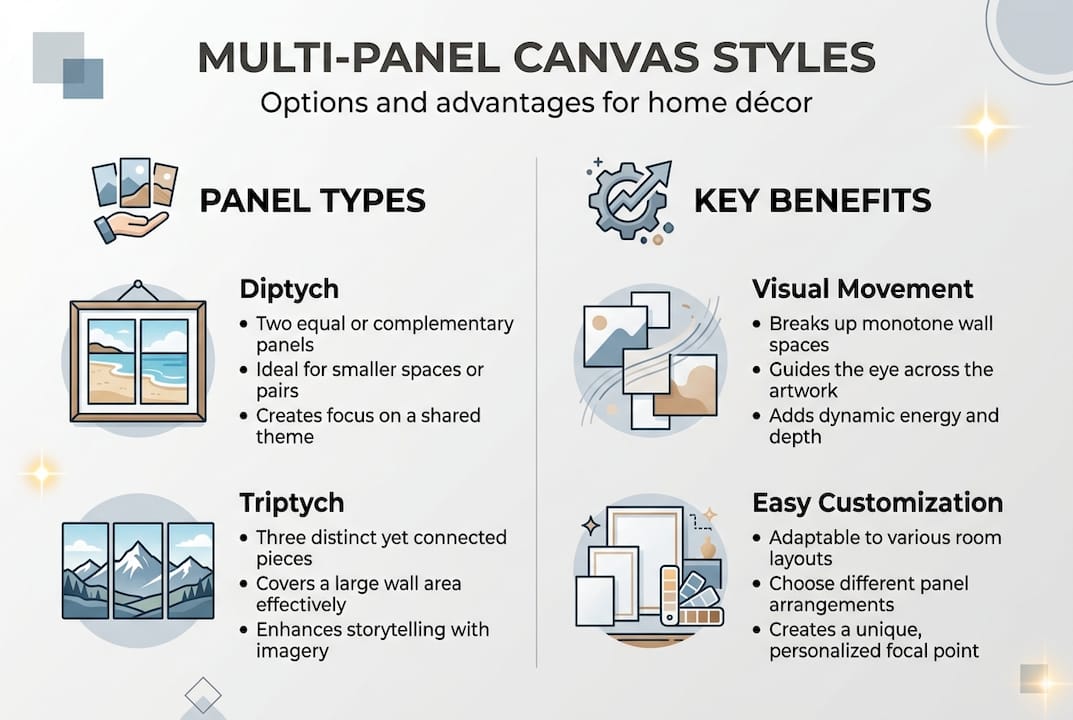
Style choices include photographic prints (nature, cityscapes, portraits), abstract art (color fields, brushstroke compositions), geometric patterns, floral motifs, and weave or cyclone designs. Abstract and geometric styles tend to age well because they aren’t tied to a specific trend or photographic moment. The modern art and mood connection is real: cooler colors and fluid patterns calm a space, while bold contrast and angular geometry energize it.
A step-by-step approach to picking a style:
- Identify the dominant color already in your room (furniture, textiles, flooring).
- Decide whether you want the art to blend in or stand out as a contrast.
- Choose a motif that reflects your personality, not just current trends.
- Pick a panel count based on your wall width (use the table above).
- Order a sample or review a digital mock-up before committing to large sizes.
Pro Tip: Odd numbers of panels almost always look more dynamic than even numbers. A triptych has natural visual tension because the eye can’t split it evenly. Even-numbered sets like quads work beautifully when symmetry is intentional and the layout is perfectly centered. If you’re unsure, start with three. Vibrant triptych prints in a weave design are a perfect example of how three panels create something that two or four panels simply wouldn’t.
Benefits of multi-panel canvas prints for home décor
Style options are one thing. The practical and emotional benefits of going multi-panel are another conversation entirely, and they’re worth understanding before you invest.
The most immediate advantage is visual movement. Because a set of panels spans a wider area than a single canvas, your eye naturally travels across the wall. This creates what interior designers call a focal point (a central area that draws attention when you enter a room). A strong focal point makes a room feel purposeful and designed rather than random.
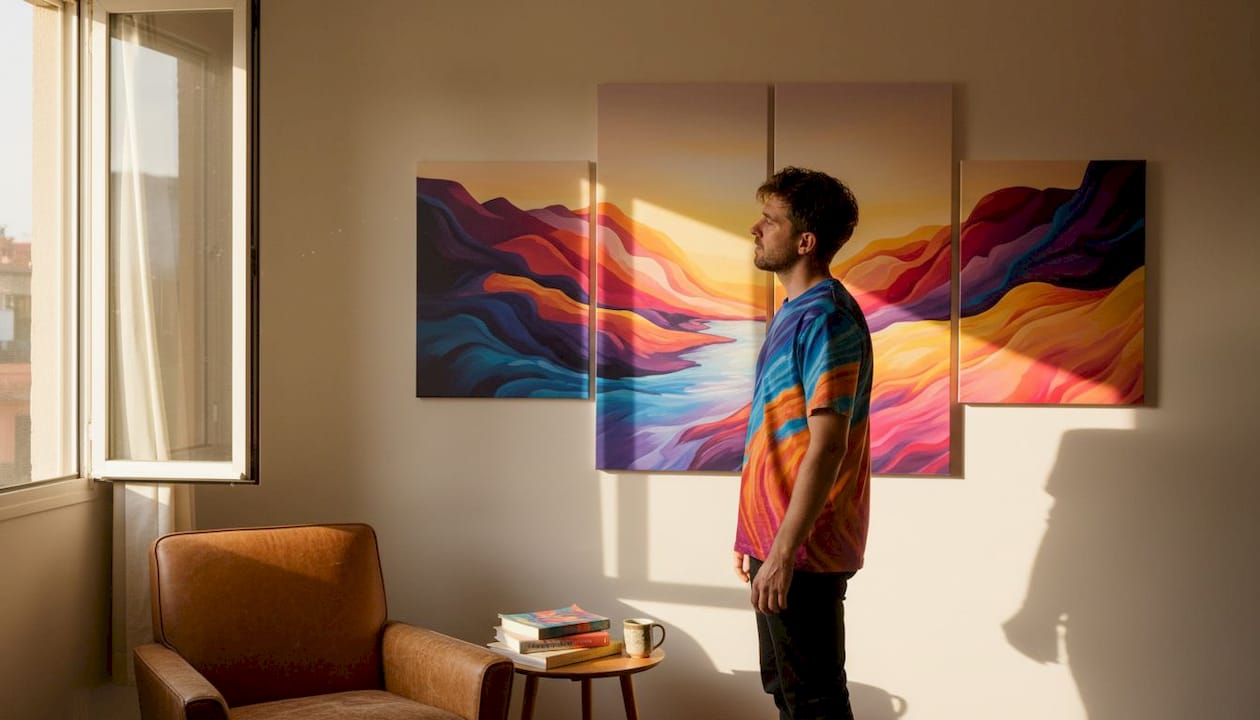
Multi-panel art also visually expands space. A well-placed horizontal triptych along a narrow wall draws the eye sideways, making the room feel wider than it is. This is a well-known design technique, and modern art that transforms living rooms often relies on this principle to improve mood and perceived space.
Here are the core benefits at a glance:
- Creates a focal point that anchors the room visually
- Adds depth and dimension to flat, boring walls
- Allows for easy updates since individual panels can be swapped without replacing the entire set
- Offers personalization through color, image, layout, and size choices
- Works across multiple rooms, from bedrooms to offices to hallways
“Art arranged with intention transforms a room from a place you live in to a place that reflects who you are.” Interior designers consistently note that the arrangement of art, not just the art itself, drives the emotional experience of a space.
The personalization angle deserves special attention. Unlike furniture or paint color, wall art is one of the easiest and most affordable ways to update a room’s look seasonally or as your taste evolves. Customizing wall art is a growing trend, with many buyers now selecting specific color palettes, personal photos, or abstract designs that reflect their identity rather than defaulting to whatever is on the shelf. Canvas print styling guides also note that personalized sets create emotional resonance in a room that generic mass-market art rarely achieves.
Pro Tip: If you’re unsure which colors to choose, pull a palette from a textile you already love, such as a rug or throw pillow. Use those same hues in your multi-panel selection and the room will feel intentionally layered rather than pieced together.
A stat worth noting: studies on interior design satisfaction consistently show that people feel more at home and more relaxed in spaces where they recognize their own taste and personality in the decor. Art is one of the fastest ways to create that recognition.
How to select and style multi-panel canvas prints
Knowing the benefits is great. Knowing exactly how to pick and hang your panels is even better. This section walks you through the entire process from blank wall to finished display.
Step 1: Measure your wall. Write down the width and height of the area you want to fill. Leave at least 6 inches of open wall on each side of the total arrangement. This breathing room prevents the display from feeling cramped.
Step 2: Choose a color direction. Look at the existing palette in the room. Are you working with warm neutrals, cool grays, or bold saturated tones? For advice on selecting the right wall art style, match at least one color in the art to something already in the room. This creates cohesion without making the art disappear into the background.
Step 3: Decide on layout before you buy. Use painter’s tape on the wall to mock up the panel positions before anything is ordered or hung. This lets you see the actual scale in context and adjust before committing.
Step 4: Hang at the right height. The center of your arrangement should sit at approximately 57 to 60 inches from the floor. That’s roughly eye level for most adults and the standard used by most galleries. For art hung above furniture like a sofa or console table, leave 6 to 8 inches between the top of the furniture and the bottom of the lowest panel.
Here’s a numbered process for installation day:
- Mark the center point of your wall space with a small pencil dot.
- Use a level and measuring tape to mark each panel’s top corner positions.
- Double-check spacing between panels with a ruler before hammering any nails.
- Hang the center panel first (for triptychs and quads), then work outward.
- Step back after each panel to check alignment before proceeding.
- Use adhesive strips for rental-friendly installation without wall damage.
Common mistakes to avoid:
- Hanging too high. This is the most frequent error and makes art feel disconnected from the furniture below.
- Ignoring room lighting. Natural and artificial light affects how colors look on the wall. Check the art under your actual room lighting, not just in a showroom.
- Mixing too many frame styles. If your panels have gallery wrap edges, keep all panels consistent with the same edge style and depth.
- Going too small. When in doubt, size up. A set that’s slightly larger than expected almost always looks better than one that gets lost on a big wall.
For more practical guidance on placement and spacing, these tips for styling canvas prints cover additional room-specific scenarios in useful detail.
Why the right art arrangement matters more than you think
Most people spend weeks researching which art to buy and about five minutes thinking about how to arrange it. That’s backwards, and it’s the single biggest reason beautifully designed pieces end up looking flat on a wall.
Here at ColorMelt, we’ve seen this pattern play out consistently. A stunning abstract triptych, printed with vivid fade-resistant color, gets hung slightly off-center or too high, and the entire effect collapses. The art is blamed when the arrangement is the actual problem.
Spacing is where most people lose the most impact. Tight spacing (1 inch or less) reads as a single large piece, which is sometimes exactly what you want. Wider spacing (3 or more inches) gives each panel independence and creates a gallery-wall feel. Neither is wrong, but the choice has to be intentional. A multi-panel print isn’t just a decoration placed on a wall. It’s a narrative that unfolds across space, and the gaps between frames are part of the story. When you transform a room with art, the arrangement carries as much weight as the art itself. Give it the same attention you’d give to choosing which piece to buy.
Bring your walls to life with vibrant multi-panel canvas art
Ready to turn a blank or boring wall into something that genuinely reflects your style? At ColorMelt, we’ve built a collection specifically designed to make multi-panel decorating feel effortless and exciting.
Our curated range includes acrylic triptych prints, weave-design sets, cyclone abstracts, and vibrant floral arrangements, all printed with fade-resistant inks on gallery-quality materials. Whether you’re styling a cozy bedroom corner or a sprawling open-plan living area, we have panel configurations and sizes designed to fit your exact wall. Every piece ships quickly and arrives ready to hang. Browse the full collection at ColorMelt.shop and find the multi-panel set that speaks to your space.
Frequently asked questions
Are multi-panel canvas prints suitable for small spaces?
Yes, choosing a horizontal diptych or compact triptych in a smaller size can actually make a narrow or small room feel wider and more open, as modern art placement works to visually expand the perceived dimensions of a space.
How do you hang multi-panel canvas prints evenly?
Mark anchor points with a level and use a measuring tape to maintain identical spacing between each panel; most quality panel sets include pre-attached hanging hardware to simplify accurate placement.
Can I customize colors and designs for a multi-panel canvas print?
Yes, many retailers offer full customization so you can choose your preferred color palette, imagery, and panel configuration, and styling guides for canvas prints recommend personalizing at least the color direction to tie the art to your existing room palette.
What is the best panel arrangement for a modern living room?
A triptych or quad layout is ideal for modern living rooms, especially when displayed above a sofa or large console, as acrylic triptych formats offer balanced symmetry and strong visual impact across wider walls.
How much space should be between each panel?
A gap of 1 to 3 inches is the standard recommendation, though you should adjust based on the total wall width and whether you want the panels to read as one unified image or as a connected but distinct series.