
Decorative Motifs in Home Decor: A 2026 Guide
A decorative motif is defined as a repeated visual unit, element, or theme used to adorn and structure surfaces, objects, or architectural features. The term comes from the Latin motivus, meaning “moving,” and in design it refers to any shape, symbol, or figure that recurs to create visual rhythm and order. Motifs appear on everything from ancient Greek pottery to modern canvas prints, making them one of the most enduring tools in art and design. Understanding what a decorative motif is gives you a direct advantage when choosing art for your home, because you stop reacting to surfaces and start reading them.
What is a decorative motif and how does it work?
A decorative motif functions as both aesthetic ornament and a compositional tool, creating visual rhythm and organization across surfaces like walls, fabrics, and ceramics. That dual role is what separates a motif from a random decorative mark. A single flower painted on a vase is an illustration. The same flower repeated at measured intervals across the vase’s surface becomes a motif, because it now structures the viewer’s eye movement.
The key mechanism is repetition governed by rules. A motif acts as a building block, repeated through mirroring, rotating, or alternating to produce a cohesive pattern. Those rules are what give a finished surface its sense of order rather than chaos. When you see a wallpaper that feels calm and intentional, the repeat system behind its motif is doing most of the work.
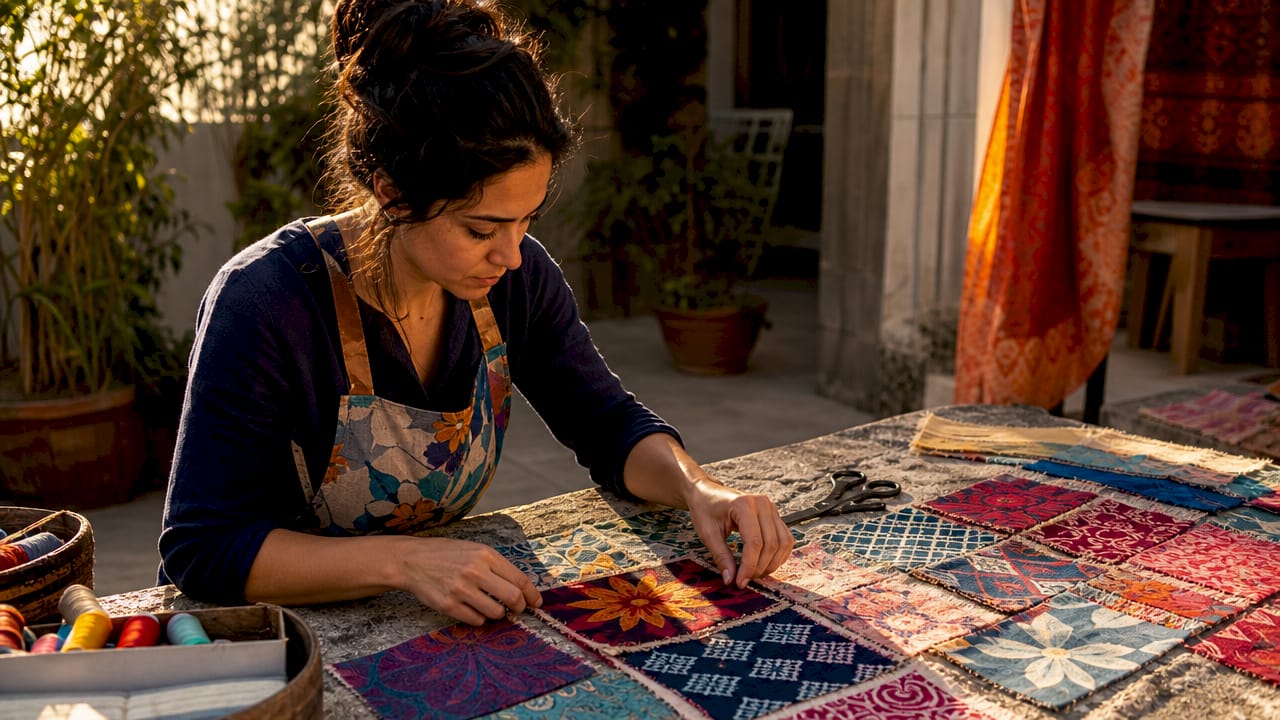
Design motifs also carry meaning beyond their visual structure. A lotus motif signals purity in Buddhist art. A chevron signals movement and direction in contemporary graphic design. Recognizing this layer of meaning helps you choose art that communicates what you actually want a room to say.
What are the main types of decorative motifs?
Decorative motifs fall into four major categories: geometric, plant and floral, traditional and cultural, and figural. Each category has distinct visual characteristics and carries different associations in global art and design.
- Geometric motifs use shapes like circles, triangles, squares, and interlocking grids. They appear in Islamic tilework, Scandinavian textiles, and modern abstract art. Geometric motifs read as ordered and rational, making them a strong choice for minimalist interiors.
- Plant and floral motifs draw from natural forms: leaves, vines, petals, and branches. The acanthus leaf in classical architecture and the lotus in Asian decorative art are two of the most recognized examples. Floral motifs in interiors bring organic warmth and are among the most versatile types across cultures and centuries.
- Traditional and cultural motifs are tied to specific communities, regions, or historical periods. The Greek key pattern, the Celtic knot, and the Adinkra symbols of West Africa each carry encoded cultural meaning. These motifs communicate identity and heritage as much as they decorate.
- Figural motifs represent animals, humans, or mythological creatures. Egyptian hieroglyphic friezes and medieval heraldic beasts are classic examples. Figural motifs tend to carry the strongest narrative weight of any category.
Pro Tip: When mixing motif types in one room, choose motifs that share a scale or color palette. A large geometric and a small floral can coexist if their colors align, but clashing scales create visual noise faster than clashing styles.
How do designers apply decorative motifs in home decor?
Applying design motifs effectively in a home requires more than picking a pattern you like. Effective motif application balances visual complexity with the surrounding environment to avoid superficial decoration. The goal is harmony, not coverage.
Designers use three primary repetition methods:
- Straight repetition. The motif repeats in a uniform grid, row after row, with consistent spacing. This creates a calm, structured surface. Classic wallpaper and tile floors use this method most often.
- Alternating repetition. Every second motif rotates, flips, or changes color. This adds visual interest without breaking the underlying order. Herringbone fabric patterns and brick-bond tile layouts work this way.
- Border application. The motif runs along edges, frames, or transitions between surfaces. Borders define zones in a room without covering entire walls. Crown molding patterns and rug borders are the most common residential examples.
The balance between motif complexity and available space determines whether a room feels rich or cluttered. A highly detailed motif needs generous negative space around it to breathe. A simple geometric motif can repeat densely without overwhelming the eye.
Pro Tip: Before committing to a motif-heavy wallpaper or fabric, test a sample panel in the actual room at different times of day. Natural light changes how a motif reads, and a pattern that looks elegant in a showroom can feel oppressive in a north-facing bedroom.
Motifs work across multiple surfaces in a single room when you treat one surface as dominant and the others as supporting. A bold abstract wall art piece with a cyclone motif can anchor a living room while a subtler geometric pattern on a throw pillow echoes it without competing.
What is the cultural and symbolic significance of decorative motifs?
The significance of decorative motifs extends far beyond aesthetics. Motifs encode cultural memory, spiritual belief, and social identity into visual form. Ignoring that layer produces decoration that looks borrowed rather than intentional.
- Classical architecture used the anthemion motif, a stylized honeysuckle or palmette flower, not only for beauty but also for symbolic connection with classical ideals of refinement and civic virtue. Seeing it on a building’s frieze communicated the owner’s alignment with Greek and Roman cultural values.
- Indigenous art traditions use motifs as living records. Australian Aboriginal dot patterns map sacred geography. Andean textile motifs encode agricultural calendars. These are not decorative choices in the Western sense. They are functional visual languages.
- Sacred and ceremonial motifs carry strict usage conventions in many cultures. Certain cultural motifs are reserved for sacred or ceremonial contexts, and using them outside those contexts reduces authenticity and can cause genuine offense. Thai Lai Kanok patterns, for example, appear in temple architecture and royal regalia. Placing them on a commercial throw pillow strips them of their intended meaning.
High-quality motif design depends on understanding the construction rules and historical context of a pattern. Applying a motif without that knowledge produces a superficial aesthetic overlay rather than meaningful design.
Respectful use of cultural motifs starts with research. Knowing where a motif originated, what community created it, and what it signifies tells you whether you are honoring a tradition or flattening it. This matters especially as global design trends make motifs from non-Western traditions increasingly visible in mainstream home decor.
What are the design principles behind creating patterns with motifs?
Pattern creation is a technical discipline with clear rules. Motifs provide rhythm and structure on surfaces, guiding the viewer’s eye through controlled, rhythmic experiences using repetition and stylization. Understanding these rules helps you evaluate finished art and make better purchasing decisions for your home.
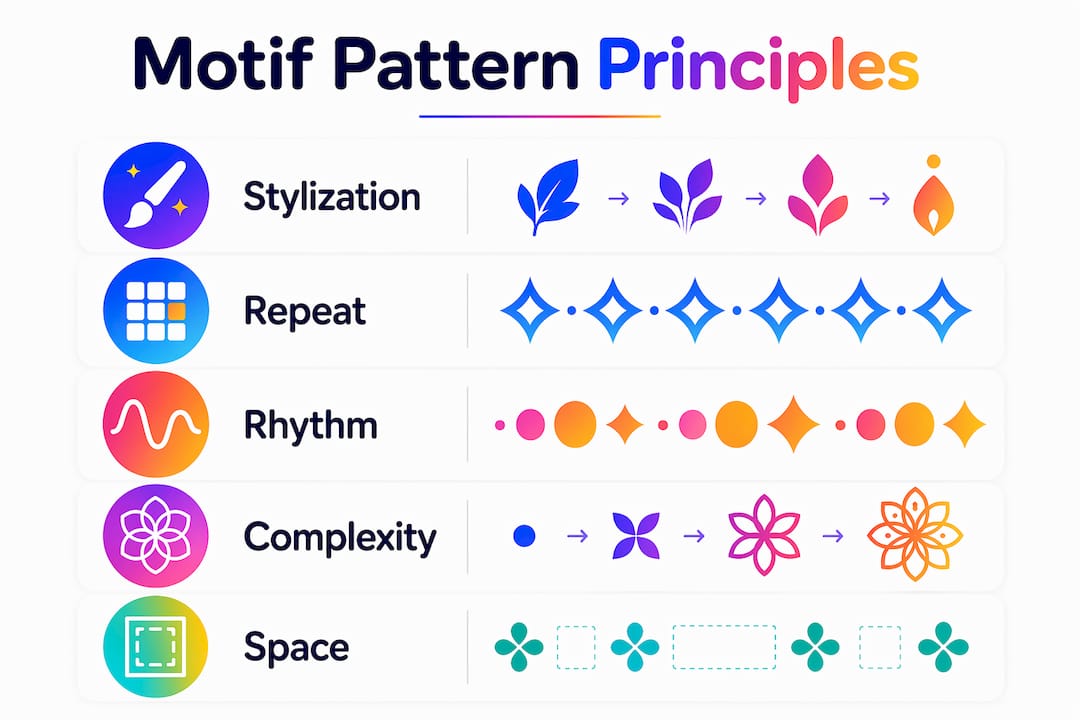
Stylization is the first principle. It means reducing a natural form, a leaf, a wave, a bird, to its most repeatable essence. Stylization simplifies natural forms into repeatable shapes, balancing complexity with negative space to avoid visual noise. A realistic rose cannot tile a surface cleanly. A stylized rose, reduced to five symmetrical petals and a circular center, can repeat infinitely without losing legibility.
Pattern repeat is the second principle. Every repeating pattern uses a grid structure, whether square, brick, half-drop, or diamond, to organize the motif’s placement. The grid is invisible in the finished piece but determines everything about how the pattern reads at scale.
Visual rhythm is the third principle. Rhythm in a pattern works like rhythm in music: it sets a pace for the eye. A tight, fast repeat creates energy. A wide, slow repeat creates calm. Choosing the right rhythm for a room depends on the room’s function. Bedrooms benefit from slower rhythms. Entryways and dining rooms can carry faster, more energetic patterns.
| Motif complexity | Recommended negative space | Best application |
|---|---|---|
| High detail | Generous, 60% or more open space | Feature wall, single art piece |
| Medium detail | Balanced, roughly 40–50% open space | Fabric, wallpaper accent panel |
| Low detail | Minimal, dense repeat acceptable | Floor tile, border trim, textile |
Pro Tip: When evaluating a patterned piece of wall art, step back six feet and squint. If the motif still reads clearly at that distance and reduced focus, the stylization is working. If it dissolves into noise, the detail level is too high for the scale.
Key Takeaways
A decorative motif is a repeated visual unit that functions as both ornament and compositional structure, and its cultural context, repeat system, and stylization level determine whether it enhances or overwhelms a space.
| Point | Details |
|---|---|
| Core definition | A motif is a repeated visual unit that creates rhythm and order, not just decoration. |
| Four main types | Geometric, floral, cultural, and figural motifs each carry distinct visual and symbolic meanings. |
| Application method | Use straight, alternating, or border repetition and match motif complexity to available space. |
| Cultural respect | Research a motif’s origin before using it; some patterns carry sacred or ceremonial restrictions. |
| Design principles | Stylization, pattern repeat, and visual rhythm are the three technical tools behind effective motif use. |
Why motifs deserve more thought than most people give them
Most people choose a patterned piece of art or fabric because it “feels right.” That instinct is real, but it skips the part where you understand why it feels right. After years of looking at how motifs work in finished interiors, I have noticed that the rooms people find most satisfying almost always have one thing in common: the motifs in them are doing two jobs at once. They are decorating the surface, and they are organizing the viewer’s attention.
The most common mistake I see is over-detailing. Someone finds a beautiful traditional motif, falls in love with its intricacy, and then scales it up to fill an entire wall. The result is exhausting. The motif was designed to be read at close range, on a textile or a manuscript border. At mural scale, it loses its structure and becomes visual noise. Scale is not just a size decision. It is a design decision.
The second mistake is treating cultural motifs as purely aesthetic raw material. A Thai Lai Thai pattern or a Navajo diamond motif carries a history that a simple geometric does not. Using it without understanding that history does not make you wrong, but it does make the result feel thin. The rooms that genuinely impress me are the ones where the owner can tell you something real about the art on their walls.
My practical advice: pick one motif type as your anchor, understand its origin well enough to explain it to a guest, and let everything else in the room support it rather than compete with it. Motifs are not decoration. They are the visual grammar of a space.
— Shlomo
Colormelt’s wall art collection for motif-inspired spaces
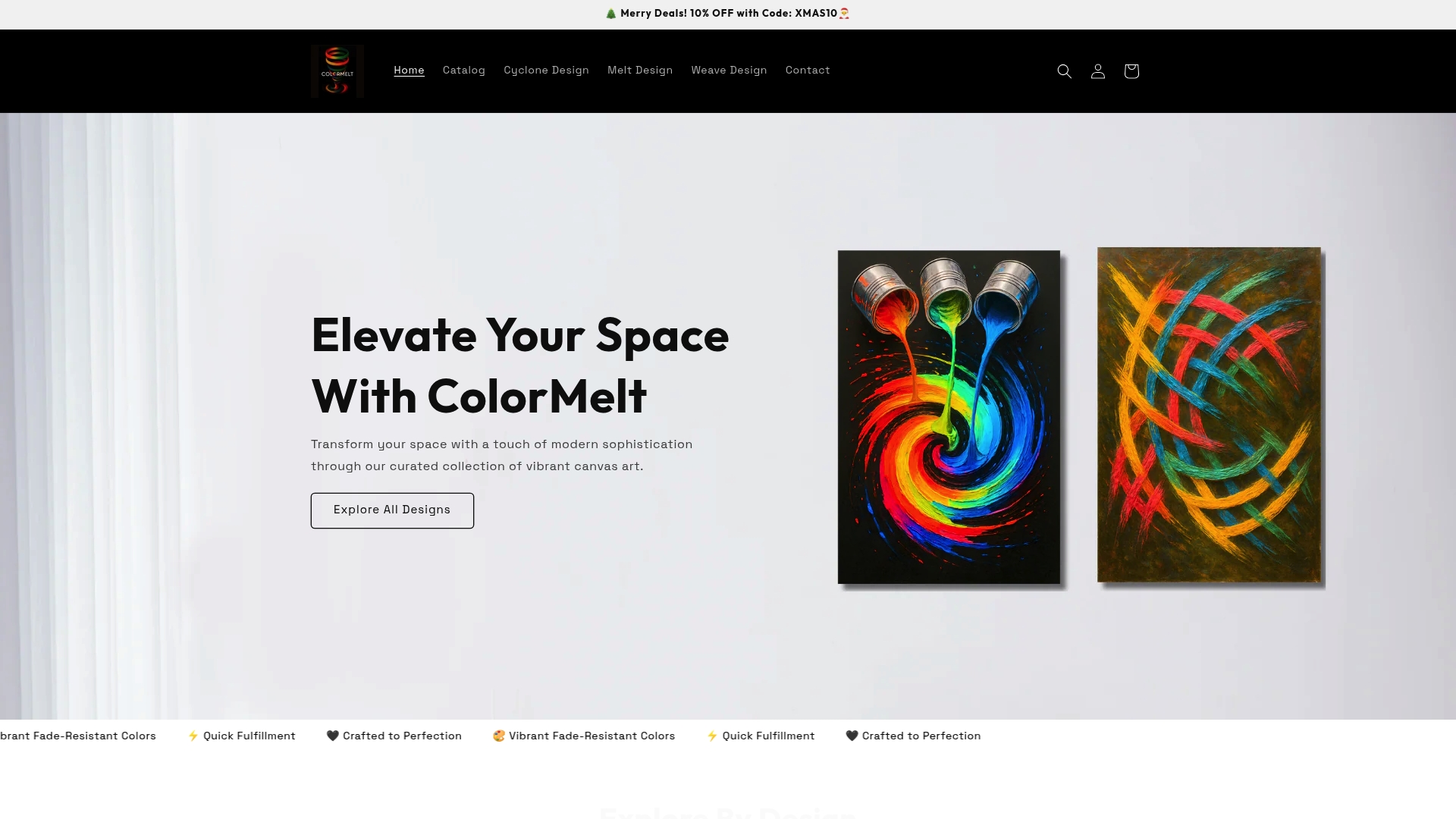
Colormelt’s wall art collection brings decorative motif principles directly into ready-to-hang pieces. The range includes abstract canvas prints built on cyclone and weave motifs, framed artwork with bold color contrasts, and metal prints that use dynamic repeat structures to create visual rhythm on any wall. Each piece uses fade-resistant colors and is fulfilled quickly, so the art you choose looks exactly as intended when it arrives. If you want to see how a motif-driven piece changes a room, the Weave Design framed canvas is a strong starting point. It applies the alternating repetition method at a scale that works in living rooms, offices, and bedrooms alike.
FAQ
What is a decorative motif in simple terms?
A decorative motif is a repeated visual element, such as a shape, symbol, or figure, used to ornament and organize a surface. It creates visual rhythm by following rules like mirroring, rotating, or alternating.
What are the main types of decorative motifs?
The four main types are geometric, plant and floral, traditional and cultural, and figural motifs. Each type carries distinct visual characteristics and symbolic associations used across global art and design traditions.
How do I use decorative motifs in home decor?
Apply motifs through straight repetition, alternating patterns, or border placement, and match the motif’s complexity to the available space. A highly detailed motif needs generous negative space; a simple one can repeat densely without overwhelming a room.
Why does the cultural significance of decorative motifs matter?
Some motifs are tied to sacred or ceremonial traditions, and using them without understanding their context produces decoration that feels superficial or disrespectful. Researching a motif’s origin before using it leads to more authentic and meaningful design choices.
What is the difference between a motif and a pattern?
A motif is the single repeated unit, such as one stylized leaf or one geometric shape. A pattern is the full surface design created when that motif repeats according to a grid or repeat system.