

How to Pick Canvas Print Size for Your Home
Choosing the wrong canvas print size is one of the most common and costly decorating mistakes people make. A print that’s too small gets lost on the wall and looks like an afterthought. One that’s too large crowds the space and throws off the entire room. Knowing how to pick canvas print size correctly before you order saves you money, time, and the frustration of returns. This guide walks you through measuring your space, applying practical sizing formulas, and matching canvas dimensions to your room’s function and style so you get it right the first time.
Table of Contents
- Key Takeaways
- How to pick canvas print size: start with your wall space
- Applying sizing formulas for exact canvas dimensions
- Matching canvas size to room function and decor style
- Common sizing mistakes and how to fix them
- My honest take on canvas sizing
- Find the perfect canvas at Colormelt
- FAQ
Key Takeaways
| Point | Details |
|---|---|
| Measure before you order | Use wall width and height to calculate a target size range before selecting any canvas. |
| Apply the 60%–75% rule | Wall art should cover 60% to 75% of available wall space for a balanced, proportional look. |
| Use furniture as your anchor | Canvas art hung above a sofa or bed should span roughly two-thirds the furniture’s width. |
| Match size to room function | Living rooms support larger statement pieces while offices and bedrooms often call for mid-size or grouped prints. |
| Visualize before you commit | Tape paper cut to your target dimensions on the wall before purchasing to preview the real impact. |
How to pick canvas print size: start with your wall space
Before you think about style, color, or subject matter, you need hard numbers. Pull out a tape measure and write down the width and height of the wall section where you plan to hang your canvas. That gives you a working boundary, not a guess.
Now subtract anything that interrupts the wall: furniture pushed against it, architectural moldings, light switches, or vents. What remains is your usable wall space. That number is what drives your canvas sizing decision.
The 60%–75% wall coverage rule
The most reliable starting point in any canvas print size guide is this: wall art should fill between 60% and 75% of the available wall space that isn’t blocked by furniture or moldings. To apply it, multiply your usable wall width by 0.60 to get the minimum target width and by 0.75 to get the maximum. That range gives you a size window to work within.
Here’s what that looks like with real numbers:
| Wall width (usable) | Minimum canvas width (×0.60) | Maximum canvas width (×0.75) |
|---|---|---|
| 48 inches | 29 inches | 36 inches |
| 60 inches | 36 inches | 45 inches |
| 72 inches | 43 inches | 54 inches |
| 84 inches | 50 inches | 63 inches |
You don’t need to hit those numbers exactly. You need to stay inside that range. A canvas that lands below the 60% threshold tends to look small and unintentional. One that pushes past 75% starts to compete with the room rather than complement it.
- Measure width and height of the full wall section
- Subtract furniture, trim, and architectural features
- Calculate 60% and 75% of the remaining width
- Use those two numbers as your lower and upper size limits
- Write dimensions down before opening any product page
Pro Tip: Tape a piece of painter’s tape along the wall at your minimum and maximum widths before ordering. Stand back and look at it from across the room. That simple test reveals more than any online visualization tool.
Applying sizing formulas for exact canvas dimensions
Once you have your wall range, you can get more specific. The most useful formula beyond the wall coverage rule is the two-thirds guideline for furniture placement.
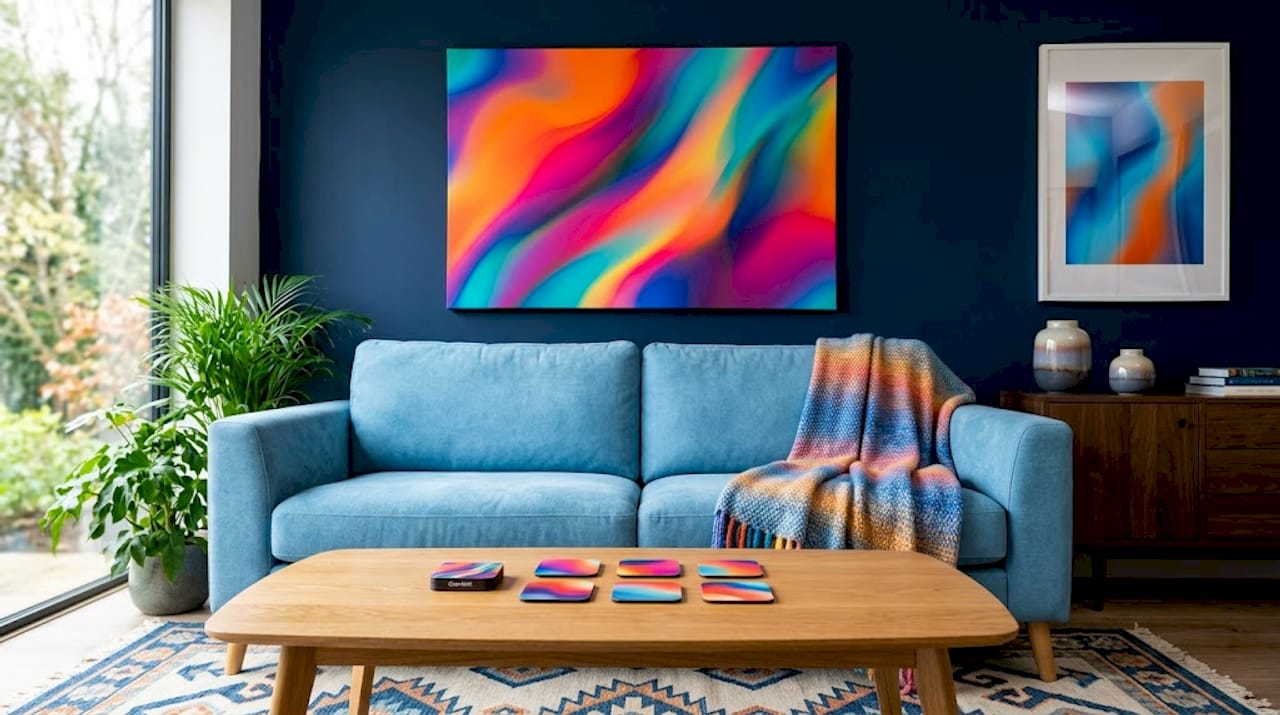
Canvas art hung above furniture should span about two-thirds the width of that piece. If your sofa is 84 inches wide, your canvas or canvas grouping should be roughly 56 inches wide. If your bed’s headboard spans 60 inches, aim for a canvas around 40 inches wide. This keeps the art visually anchored to the furniture beneath it rather than floating unconnected on the wall above.
Common canvas sizes and where they work
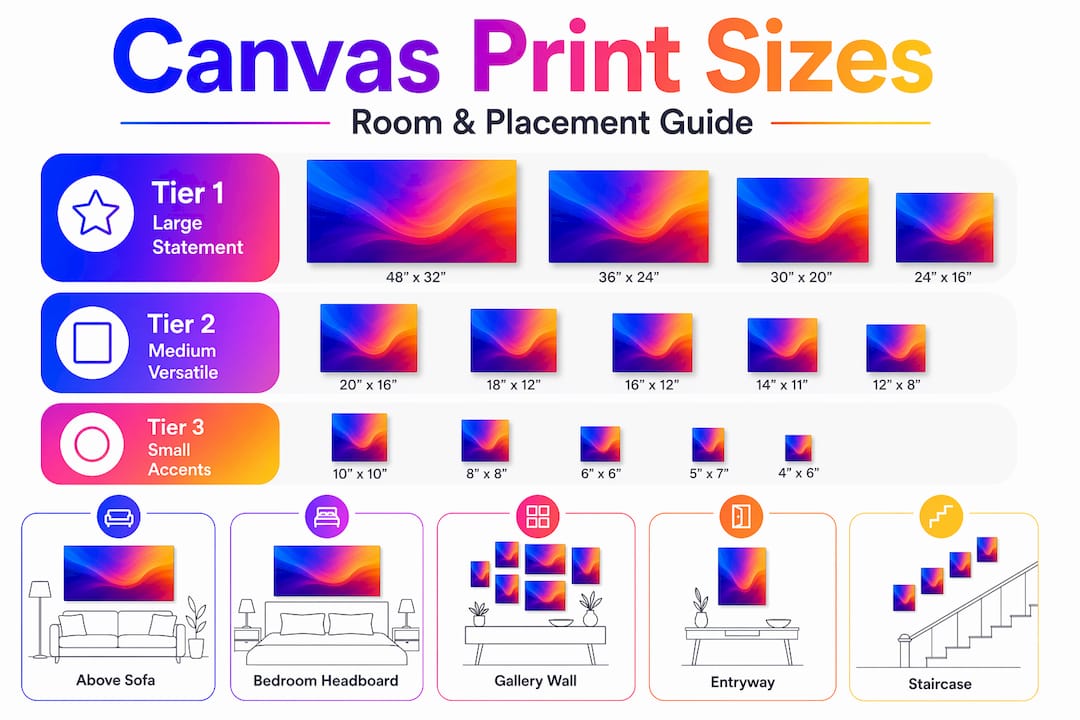
Choosing canvas print dimensions is much easier when you understand what each standard size actually does in a room. Here’s how the most popular sizes tend to perform:
| Canvas size | Best use case | Room fit |
|---|---|---|
| 8×10 inches | Clusters, gallery walls, small accents | Small rooms, hallways, desks |
| 12×16 inches | Grouped arrangements, secondary walls | Bedrooms, offices, small living rooms |
| 16×20 inches | Solo accent piece or gallery anchor | Most rooms, above a console or desk |
| 20×24 inches | Mid-size statement on standard walls | Bedrooms, dining rooms, medium living rooms |
| 24×36 inches | Bold focal point on larger walls | Living rooms, entryways, open plan spaces |
| 30×40 inches | Large-scale statement piece | Spacious living rooms, lofts, feature walls |
Versatile sizes like 16×20 and 24×36 are widely recommended because they’re large enough to hold a wall on their own while still fitting comfortably in most home layouts. Large formats like 24×36 and 30×40 inches are better reserved for walls that genuinely need a bold anchor point, not every room.
Pro Tip: When choosing between two sizes, size up rather than down. Most people regret going too small. A slightly larger canvas almost always looks more intentional and confident in a space.
Matching canvas size to room function and decor style
The best size for canvas art is not just a math problem. It’s also a context problem. A 30×40-inch abstract print that looks stunning in a high-ceiling living room can feel suffocating in a small bedroom. Room function shapes how you experience scale.
Living rooms are where large, singular statements work best. You typically have high ceilings, generous wall space, and viewing distance that allows a big piece to breathe. A 24×36 or 30×40-inch canvas on the wall above a sofa creates the kind of focal point that pulls a living room together.
Bedrooms call for a different approach. The art sits closer to you, and the mood is quieter. Mid-size pieces in the 20×24-inch range work well above a headboard, while small prints like 8×10 or 12×16 inches grouped together on a side wall add personality without overpowering the space. If you’re working on bedroom decor balance, err on the side of restraint with individual pieces and fill space with curated groupings instead.
Home offices lean toward mid-size canvases that inspire without distracting. A single 16×20 or 20×24-inch piece behind or beside your desk provides visual interest without demanding attention during a call.
- Living room: Large singular pieces (24×36 or bigger) above sofas or on focal walls
- Bedroom: Mid-size above the headboard; small grouped prints on side walls
- Home office: Single mid-size prints positioned to frame the work area without dominating it
- Hallway: Vertical formats or a series of smaller prints in a linear arrangement
- Dining room: A single mid-to-large piece centered on the main wall works better than a gallery cluster
For help arranging multiple prints in the same space, a room-by-room layout plan makes the process much more manageable. You can also explore specific room-by-room canvas styling ideas to see how sizing and placement interact across different spaces.
Common sizing mistakes and how to fix them
Even with good measurements, people still run into the same problems. Knowing what they are in advance means you don’t have to learn them the hard way.
Going too small. This is the number one canvas print sizing mistake. A single 8×10 on a large wall looks like a postage stamp. If your measurement range says 36 to 45 inches wide, don’t order a 20-inch piece because you think it looks cute in the product photo.
Ignoring the vertical dimension. Most people measure wall width and stop there. But height matters too. A very wide, short canvas on a tall wall creates an awkward horizontal strip that draws attention to how empty the wall still looks above and below it.
Ordering without visualizing. This is completely avoidable. Cut newspaper or craft paper to your target dimensions and tape it to the wall. Live with it for a day. Walk past it from different angles and distances. Gallery-wrapped canvas prints also have side-wrapped images that add a few inches of visual presence beyond the frame, so account for that depth when visualizing.
- If your target size falls between standard dimensions, go up to the next standard size
- For gallery walls, mock up the entire arrangement with paper templates before ordering anything
- Avoid mixing wildly different sizes in the same grouping unless one piece is clearly the dominant anchor
- Account for hanging hardware: your canvas will sit a few inches lower than where you hammer the nail
Pro Tip: If you’re ordering a canvas for a wall you’ve never decorated before, use the furniture two-thirds rule as your primary guide rather than the wall rule. It gives you a more human-scale reference point and almost always produces a more natural-looking result.
My honest take on canvas sizing
I’ve made every mistake described in this article. I once ordered a 16×20 canvas for a wall that called for at least a 30×40, and I convinced myself it looked fine for about two weeks before I admitted it looked wrong every single time I walked past it.
What changed for me was treating the measurement step as non-negotiable rather than a rough suggestion. The first time I taped paper to the wall at the calculated dimensions before ordering, I was genuinely surprised by how different the space looked compared to what I had imagined. The number that felt “too big” on paper looked exactly right on the wall.
The two-thirds furniture rule is the single most underused piece of sizing advice I’ve come across. Most people anchor their decision to the wall and forget about the furniture below. But your eye naturally connects the art to the piece it hangs above, not to the empty wall around it. Getting that relationship right makes artwork look like it belongs rather than like it was placed somewhere convenient.
My advice: do the math, tape the paper, then order with confidence. The preparation work takes fifteen minutes and saves you from a decision you’ll second-guess every morning.
— Shlomo
Find the perfect canvas at Colormelt
Now that you have a clear sizing framework, the next step is finding art that’s actually worth hanging.

Colormelt’s wall art collection includes canvas prints in a range of sizes designed to work across different room types and wall configurations. From bold abstract designs that command a living room feature wall to intricate patterns that reward a closer look in a bedroom or office, there’s a piece scaled for the space you’re decorating. Check out the Cyclone Design canvas if you need a high-impact piece for a larger wall, or explore the full collection for options that match your measured size range. Every print is made with fade-resistant colors and ships quickly so you can get your walls done without the wait.
FAQ
What is the 60%–75% rule for canvas sizing?
Wall art should cover 60% to 75% of the available wall space not blocked by furniture or moldings. Multiply your usable wall width by 0.60 and 0.75 to get your minimum and maximum canvas width targets.
What canvas size works above a sofa?
Canvas art above a sofa should span about two-thirds the sofa’s width. For an 84-inch sofa, aim for a canvas or grouping that’s roughly 56 inches wide.
What size canvas is best for a bedroom?
A 20×24-inch canvas works well above a headboard in most bedrooms. Smaller prints like 8×10 or 12×16 inches are better suited to side walls, nightstand areas, or gallery clusters.
How do I visualize a canvas size before buying?
Cut paper or newspaper to your target canvas dimensions and tape it to the wall. Stand back and assess from normal viewing distance. This shows you the actual scale far better than imagining it from a product page.
What are the most versatile canvas print sizes?
16×20 and 24×36-inch canvases are the most broadly useful sizes because they work as standalone pieces in most rooms while being large enough to hold visual weight on their own.