

Wall Art Size Selection Guide for Every Room
Correct wall art sizing is defined by measuring your available space and applying proportional rules that create visual balance with your room’s dimensions and furnishings. A piece that is too small floats awkwardly on a large wall. A piece that is too large overwhelms the furniture beneath it. This wall art size selection guide gives you the exact measurements, coverage rules, and room-by-room standards that interior designers use. You will learn the 60–75% coverage rule, the golden ratio method, and how frame and matting affect your final dimensions before you buy a single piece.
How do you measure your walls and furniture for ideal wall art size?
Accurate measurement is the foundation of every good sizing decision. Skipping this step is the single most common reason art looks wrong after it is hung.
Step 1: Measure your wall width and height. Use a tape measure or a laser measure for longer spans. Write down both dimensions. Note any obstructions like windows, doors, light switches, or vents that reduce your usable wall space.
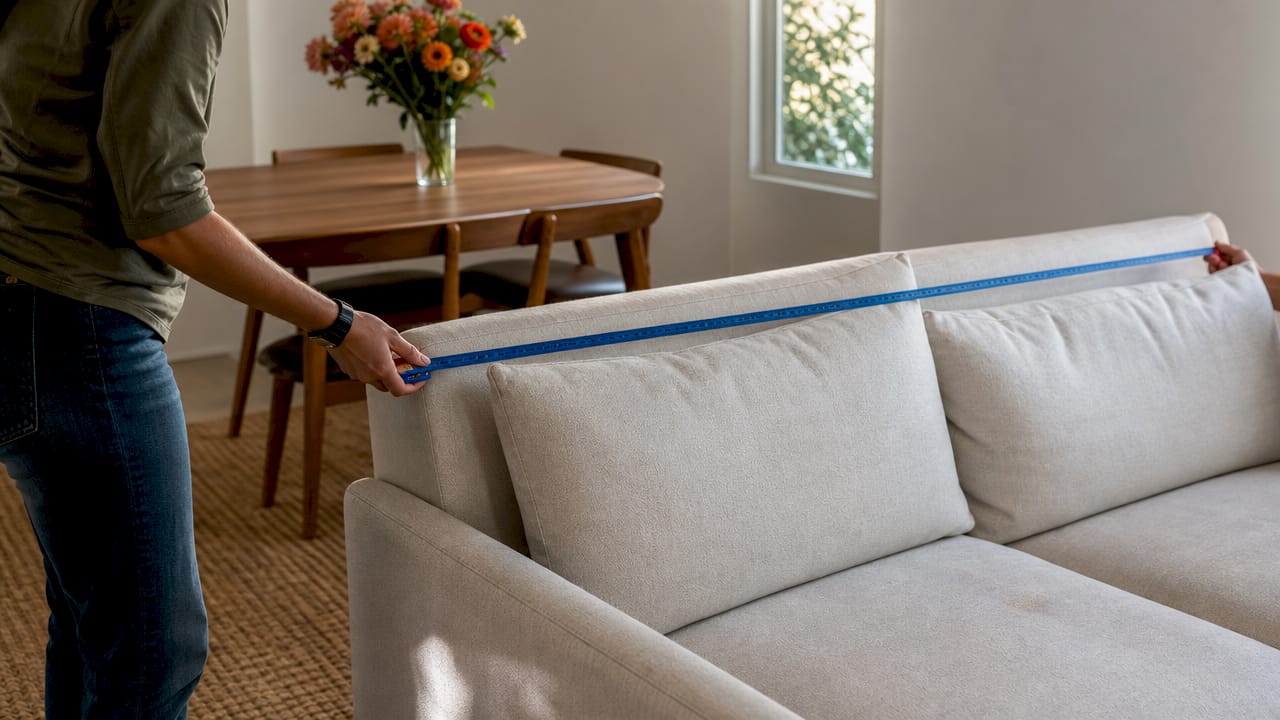
Step 2: Measure the furniture beneath the intended art. For a sofa, measure its full width from arm to arm. For a bed, measure the headboard width. For a console or sideboard, measure the top surface width. These numbers directly determine your art’s maximum width.
Step 3: Record your clearance space. Standard gallery practice centers artwork at 57–60 inches from the floor. Leave 6–10 inches between the top of your furniture and the bottom edge of the art. This gap creates a visual connection without making the art feel like it is sitting on the furniture.
Step 4: Measure your frame and matting. A 12x18 inch print can become a 16x20 inch framed piece once framing is added. Neglecting this step leads to undersized selections that look lost on the wall. Always work from the final framed dimensions, not the print size.
Pro Tip: Tape out the art’s dimensions directly on your wall using painter’s tape before ordering. Live with the outline for a day. You will immediately see if the scale feels right.
What are the proportional rules for wall art sizing?
Interior designers rely on two core rules for sizing art relative to walls and furniture. Both rules exist because the human eye reads proportion instinctively.
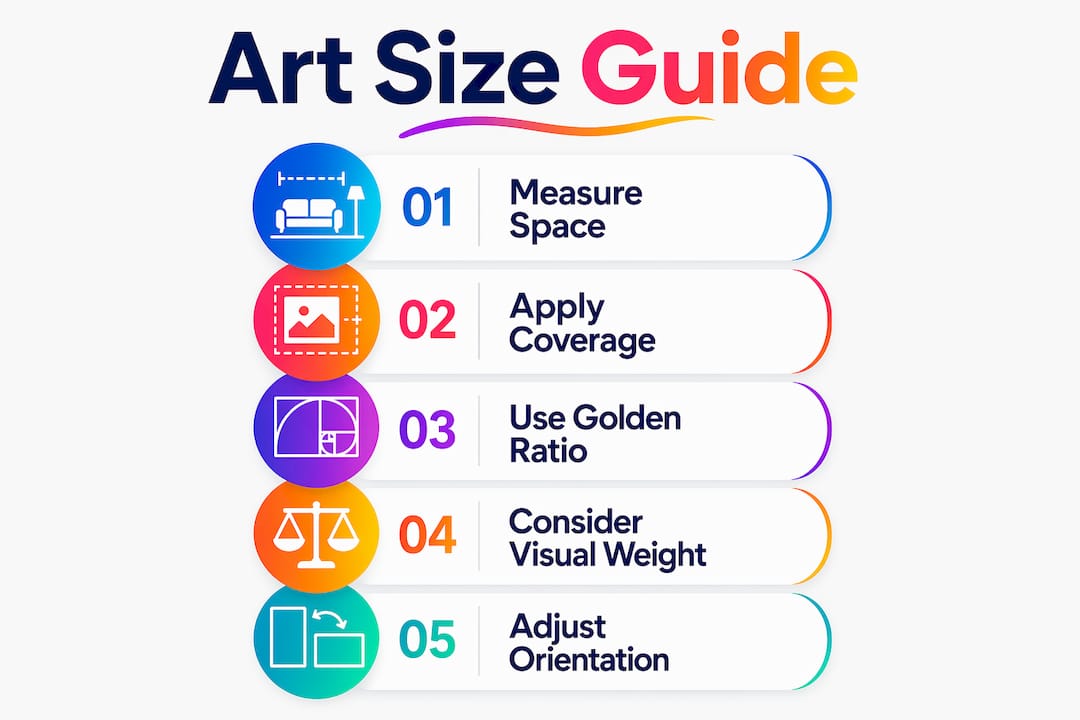
The 60–75% coverage rule
Art should fill 60–75% of available wall space on a blank wall to avoid looking too small. On a 120-inch wide wall, that means art widths between 72 and 90 inches. This rule applies whether you hang a single large piece or a gallery arrangement that collectively covers that range.
The same percentage applies above furniture. Art above a sofa should cover 60–75% of the sofa’s width. For a standard 84-inch sofa, that translates to art between 50 and 63 inches wide. Going narrower makes the art look like an afterthought.
The golden ratio method
The golden ratio of 1.618 gives you a mathematically pleasing art width for any wall. Divide your wall width by 1.618 to find the ideal art width. For a 100-inch wall, that produces an art width of roughly 62 inches. This method works especially well for statement walls where you want one dominant piece.
Visual weight and frame considerations
Visual weight changes how size is perceived. Darker or high-contrast art feels visually larger than lighter-toned pieces of the same physical dimensions. A bold abstract canvas in deep navy reads as larger than a pale watercolor at the same size. Account for this when you choose between sizing up or down. Frames add visual weight too, so a heavy ornate frame on a mid-size print can read as a large piece even if the print itself is modest.
Here is a quick reference for the two main sizing scenarios:
| Scenario | Coverage target | Example |
|---|---|---|
| Art above sofa or bed | 60–75% of furniture width | 50–63 inches wide for an 84-inch sofa |
| Art on a blank wall | 60–75% of wall width | 72–90 inches wide for a 120-inch wall |
| Golden ratio method | Wall width ÷ 1.618 | 62 inches wide for a 100-inch wall |
| Clearance above furniture | 6–10 inches gap | Bottom of art 6–10 inches above sofa back |
Key factors that affect your final size choice:
- Frame and matting add 2–4 inches per side to print dimensions
- High-contrast or dark art reads larger than its physical size
- Gallery arrangements count as one combined visual unit for coverage calculations
- Ceiling height above 9 feet calls for larger or taller pieces to fill vertical space
How does orientation and room context influence size selection?
Orientation is not just an aesthetic preference. It is a structural decision based on your wall’s shape and the room’s function.
Horizontal art suits longer, wider walls. Vertical art fits tall, narrow walls better. A horizontal canvas above a wide sofa reinforces the sofa’s horizontal line and grounds the seating area. A vertical piece in a narrow hallway draws the eye upward and makes the space feel taller.
Larger rooms with high ceilings benefit from larger pieces, often vertical or oversized statement formats. A single 36x48 inch canvas can disappear in a room with 12-foot ceilings. In that context, a 48x72 inch piece or a multi-panel arrangement works far better. You can find specific guidance on scaling art for tall spaces in Colormelt’s arrangement guide.
Common mistakes to avoid with orientation and scale:
- Hanging a small piece on a large blank wall without grouping it with other pieces
- Choosing vertical art for a wide, low wall, which makes the room feel unbalanced
- Ignoring the room’s primary sightline. Art should be visible from the main entry point or seating position
- Spacing gallery wall frames more than 6 inches apart, which breaks the visual grouping
Spacing between frames should be 2–6 inches depending on artwork size. Smaller pieces use tighter spacing to read as a cohesive group. Wider spacing works for larger individual pieces in a loose arrangement.
Pro Tip: For rooms where you are usually seated, like a dining room or home office, lower your art slightly. The goal is for the center of the piece to align with your eye level when seated, not when standing.
What are room-by-room wall art size guidelines?
Every room has a different primary furniture anchor and a different viewing distance. Both factors change the ideal art size.
| Room | Recommended art width | Hanging height (center) | Key rule |
|---|---|---|---|
| Living room (above sofa) | 50–63 inches (for 84-inch sofa) | 57–60 inches from floor | 60–75% of sofa width |
| Bedroom (above headboard) | 60–75% of headboard width | 57–60 inches from floor | Leave 6–8 inches above headboard |
| Dining room | Proportional to table width | 54–57 inches from floor | Align with seated eye line |
| Hallway | 75% of wall width, vertical format | 57–60 inches from floor | Vertical orientation for narrow walls |
| Blank statement wall | 60–75% of wall width | 57–60 inches from floor | Single piece or gallery group |
In dining rooms, lower the hanging height to 54–57 inches to align with the seated eye line. This is one of the most overlooked adjustments in home décor. Art hung at standing eye level in a dining room ends up above your line of sight every time you sit down to eat.
For bedrooms, Colormelt’s bedroom wall art ideas guide covers sizing specific to different headboard styles and bed widths. A king bed with a wide upholstered headboard calls for art in the 60–72 inch range. A twin or full bed works well with a single piece in the 24–36 inch range.
For small spaces, the instinct to go small is usually wrong. One well-sized piece creates more visual order than several undersized ones. Colormelt’s guide on art for compact rooms explains how to use scale strategically in tight spaces.
Key Takeaways
Correct wall art sizing depends on measuring your space accurately, applying the 60–75% coverage rule, and adjusting for room function, orientation, and frame dimensions.
| Point | Details |
|---|---|
| Measure before you buy | Record wall width, furniture width, and clearance space before selecting any piece. |
| Apply the 60–75% rule | Art should cover 60–75% of the wall or furniture width it hangs above. |
| Account for frames | A framed piece is 2–4 inches larger per side than the print size listed. |
| Match orientation to wall shape | Use horizontal art on wide walls and vertical art on tall, narrow walls. |
| Adjust height by room | Lower art to 54–57 inches in dining rooms to match the seated eye line. |
What I have learned from getting wall art sizing wrong
By Shlomo
The first time I hung art in my own living room, I bought a piece I loved and hung it without measuring anything. It was a 20x24 inch canvas above a 90-inch sofa. It looked like a postage stamp. I have made that mistake exactly once.
The rule most buyers skip is the frame measurement. You fall in love with a print online, order it, and then realize the framed version is 6 inches wider and 6 inches taller than you planned for. That changes everything about where it fits. Always work from the final framed dimensions.
The other thing I have come to believe strongly: visual weight matters more than physical size. A high-contrast piece with deep blacks and vivid color reads as dominant even at a modest 24x36 inches. A pale, low-contrast piece at 40x50 inches can feel like it barely registers. When you are deciding between two sizes, factor in the color and contrast of the specific piece, not just the numbers.
My honest advice is to trust the 60–75% rule as your starting point, then adjust by one size up or down based on the visual weight of the piece you love. The guidelines exist because they work. But your eye is the final judge.
— Shlomo
Colormelt’s wall art collection, sized for every space
Choosing the right size is only half the equation. The piece itself needs to be worth hanging.

Colormelt offers wall art prints in a range of sizes designed to fit the proportional rules covered in this guide. From bold abstract canvas prints to wood prints and acrylic pieces, every item is produced with fade-resistant colors and crafted for lasting quality. Whether you need a statement piece for a blank living room wall or a smaller accent for a hallway niche, the collection covers the full size spectrum. Browse by format, including the Weave Design art print and the Cyclone Design canvas, to find pieces that fit your measurements and your style.
FAQ
How big should wall art be above a sofa?
Art above a sofa should cover 60–75% of the sofa’s width. For a standard 84-inch sofa, that means art between 50 and 63 inches wide.
What is the standard hanging height for wall art?
The gallery standard is to center artwork at 57–60 inches from the floor. In dining rooms, lower this to 54–57 inches to align with the seated eye line.
Does frame size affect which wall art size I should order?
A framed print is typically 4–8 inches larger in total than the print dimensions listed. Always calculate your final wall space needs using the framed dimensions, not the print size.
What is the golden ratio rule for wall art sizing?
Divide your wall width by 1.618 to find the ideal art width. On a 100-inch wall, that gives you roughly 62 inches, a width that reads as proportionally balanced to the human eye.
How far apart should frames be on a gallery wall?
Space frames 2–6 inches apart. Use tighter spacing for smaller pieces so they read as a unified group, and slightly wider spacing for larger individual pieces in a loose arrangement.