
What Is Abstract Art? A Guide for Students and Enthusiasts
Abstract art is defined as a visual language that communicates through color, shape, form, and line rather than depicting recognizable subjects from the real world. Unlike representational painting, abstraction treats subjective reality as the raw material, translating inner experience into pure visual sensation. Artists like Wassily Kandinsky, Jackson Pollock, and Hilma af Klint built entire careers on this premise, each developing a distinct visual vocabulary that bypassed literal depiction entirely. Understanding what abstract art is means accepting that meaning lives in the feeling a work produces, not in what it resembles.
What is abstract art and where did it come from?
Abstract art did not appear overnight. The McMaster Museum of Art frames abstraction as roughly 55 years of sustained experimentation between 1911 and 1966, a period when artists across Europe and North America collectively decided that painting did not need to show the world as the eye sees it. That shift was driven by industrialization, advances in psychology, and a growing belief that pure form and color could carry emotional weight on their own.
The history of abstract art moves through several distinct phases:
- Early pioneers (1910s): Kandinsky painted what many consider the first fully abstract work around 1911, motivated by a belief that color and form could express spiritual states. Mondrian reduced the visible world to grids of primary colors. Hilma af Klint produced large-scale abstract canvases years before either of them, though her work remained hidden until decades later.
- Interwar abstraction (1920s–1930s): Movements like Constructivism and De Stijl pushed geometric abstraction into architecture and design, treating pure form as a universal language.
- Abstract Expressionism (1940s–1950s): The center of gravity shifted to New York. Christie’s describes this as a movement defined by spontaneity and gesture, with artists treating painting as an event rather than a product. Jackson Pollock dripped and poured paint directly onto canvas laid on the floor. Willem de Kooning attacked the surface with aggressive brushwork. Mark Rothko floated luminous color fields that viewers described as meditative or even spiritual.
- Color Field painting (1950s–1960s): Artists like Rothko and Helen Frankenthaler moved away from gesture toward large, unmodulated areas of color designed to produce a pure emotional experience.
- Post-1966 diversification: Minimalism, Process Art, and later Neo-Expressionism each borrowed from abstraction while pushing in new directions.
The key insight from this timeline is that abstraction spans multiple approaches, not a single fixed style. Every generation redefined what non-representational art could do.
What are the main styles and approaches within abstract art?

The definition of abstract art covers a wide spectrum. Knowing where a work sits on that spectrum changes how you read it.
| Style | Key characteristic | Representative artist |
|---|---|---|
| Geometric abstraction | Uses precise shapes, grids, and mathematical relationships | Piet Mondrian, Kazimir Malevich |
| Lyrical abstraction | Emphasizes fluid, expressive marks and emotional spontaneity | Joan Mitchell, Sam Francis |
| Action painting | Makes the physical act of painting central to the work’s meaning | Jackson Pollock, Willem de Kooning |
| Color field painting | Relies on large areas of flat color to produce emotional states | Mark Rothko, Helen Frankenthaler |
| Non-objective art | Rejects all reference to the visible world entirely | Wassily Kandinsky, Hilma af Klint |
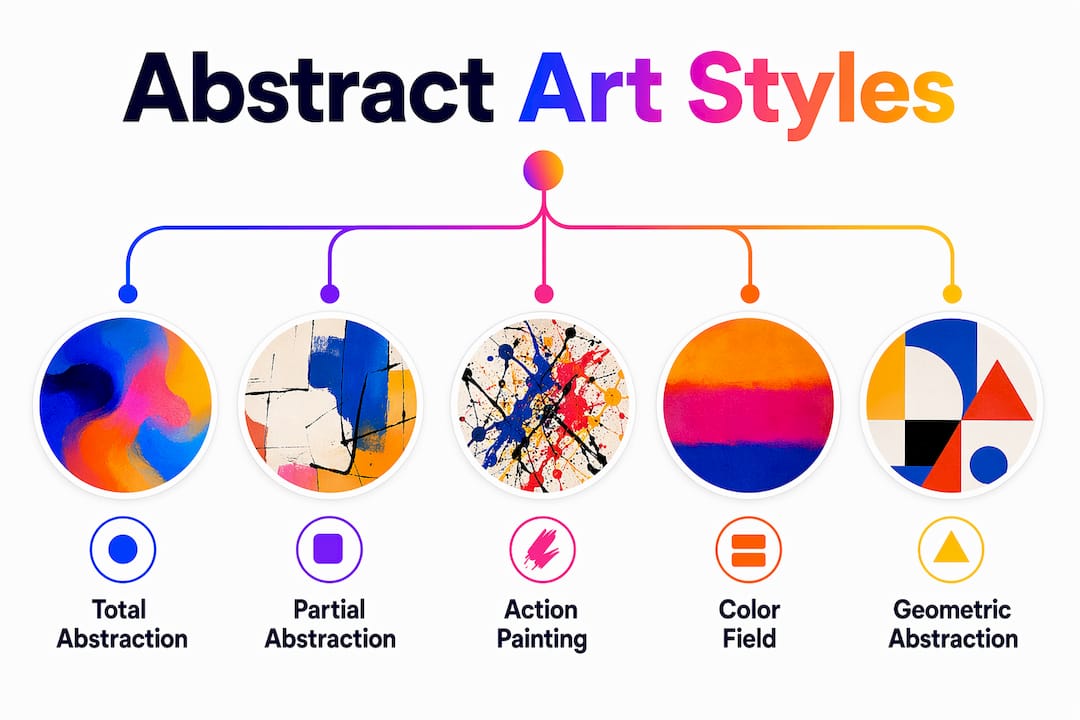
The most useful distinction for any viewer is between total abstraction and partial abstraction. Many artists start with a recognizable visual reference, a landscape, a figure, a still life, and then distort or simplify it until the original subject becomes unrecognizable. That is partial abstraction. Non-representational art, by contrast, begins with no subject at all. Kandinsky and Mondrian both worked in this territory, believing that pure forms and colors could transcend the material world and express something closer to spiritual harmony.
Within Abstract Expressionism specifically, the split between action painters and color field painters represents a genuine difference in philosophy. Action painters treat the painting process as the artwork itself. The energy, the drips, the physical marks left by the body in motion are the content. Color field painters, by contrast, strip away gesture entirely and ask the viewer to sit inside a field of color and feel something.
Pro Tip: When you look at an abstract work, ask yourself whether you sense movement or stillness. That single question will tell you whether you are looking at action painting or color field work, and it gives you an immediate entry point into what the artist was after.
What does science say about how abstract art works?
Abstract art is not random, and recent research makes that case with precision. A 2026 study using computational topology found that works by Kandinsky, Pollock, and other major abstract artists converge on specific mathematical relationships, described as Alexander duality violations, that appear to be linked to human perception. The implication is striking: artists working independently across different decades and styles arrived at the same underlying structural rules without knowing it.
The same research identified structural regularities in how abstract compositions balance edges against centers, a pattern that engages viewers emotionally even when no recognizable subject is present. This explains why standing in front of a Rothko or a Pollock produces a physical response. The composition is doing something measurable to your visual system, not just your imagination.
This finding matters for how you approach abstract art as a viewer. The work is not asking you to decode a hidden message or identify a subject. It is structured to produce a perceptual experience directly, bypassing the part of the brain that looks for familiar objects. That is why abstract art can feel more immediate than representational painting, even when it is harder to explain.
How to understand abstract art as a viewer
Understanding abstract art starts with dropping the question “What is it supposed to be?” That question assumes all art depicts something, which is exactly the assumption abstraction rejects.
Here are the most effective ways to build genuine appreciation:
- Follow the color first. Color carries emotional charge before the brain processes shape or composition. Notice whether the palette feels warm or cold, tense or calm, and let that sensation lead your interpretation.
- Track the gesture. Brushstrokes, drips, and marks record the artist’s physical movement. A Pollock canvas shows the arc of an arm, the rhythm of a body in motion. Reading gesture means reading the artist’s energy.
- Look at the edges. Abstract compositions often create tension between what happens at the center and what happens at the edges. This is where the mathematical patterns identified in recent research become visible to the naked eye.
- Spend more time. Research on eye movement shows that viewers who linger longer in front of abstract works report stronger emotional responses. Give a painting two full minutes before forming an opinion.
- Bring your own context. Abstract art communicates through subjective visual sensation, which means your personal associations are not a distraction. They are part of the work’s meaning for you.
A common beginner mistake is treating unfamiliarity as a flaw in the art. Abstract art is not difficult because it is obscure. It is unfamiliar because it operates on a different channel than representational work, one that bypasses narrative and goes straight to sensation.
Pro Tip: Before reading a wall label or artist statement, spend 60 seconds with the work alone. Your unmediated response is data. The label can add context afterward, but it should not replace what you felt first.
Contemporary artists like Tracey Emin show how abstraction continues to evolve. Emin blends abstraction with memory-driven representational marks, creating work that sits between the two modes and draws emotional power from both. This hybrid approach is increasingly common and reflects the fact that abstraction is not a closed chapter in art history. It is a living practice. If you want to see how abstract art translates into home decor, the principles of color and composition that make it powerful in a gallery work just as well on a living room wall.
Key takeaways
Abstract art is a non-representational visual language structured by color, form, and composition to produce direct emotional and perceptual responses in the viewer.
| Point | Details |
|---|---|
| Core definition | Abstract art communicates through color, shape, and gesture rather than depicting recognizable subjects. |
| Historical span | Abstraction developed across roughly 55 years of experimentation from 1911 to 1966, spanning multiple movements. |
| Style diversity | Geometric abstraction, action painting, and color field painting each pursue different expressive goals. |
| Hidden structure | Research shows abstract works by Kandinsky and Pollock follow mathematical patterns linked to human perception. |
| Viewer approach | Dropping the search for a subject and following color and gesture produces the strongest engagement with abstract work. |
Why abstract art still surprises me after years of looking at it
I have spent a long time looking at abstract art, and the thing that still catches me off guard is how physical the experience is. Standing in front of a large Rothko at the Museum of Modern Art, you do not analyze it. You feel it in your chest. That is not metaphor. The scale, the color temperature, and the compositional structure are doing something to your nervous system, and the 2026 research on mathematical patterns in abstract compositions finally gives that sensation a scientific frame.
What I find most interesting right now is the hybrid territory that artists like Tracey Emin occupy. Pure abstraction made a radical argument in 1911: that painting did not need the world as a reference point. That argument was won a long time ago. Today, the more interesting question is what happens when abstraction and representation talk to each other. The results tend to be more emotionally complex than either mode alone.
My honest view is that abstract art is the most honest form of painting because it does not pretend to show you the world. It shows you a response to the world, which is all any artist is ever really doing. Representational art just hides that fact behind a recognizable image. Abstract art puts the response front and center, and that directness is why it still feels urgent more than a century after Kandinsky made his first non-objective canvas.
If you are new to abstract art, resist the urge to resolve it into something familiar. The discomfort of not knowing what you are looking at is the beginning of actually seeing it.
— Shlomo
Bring abstract art into your space with Colormelt

Abstract art’s power does not belong only in galleries. The same principles of color, composition, and emotional resonance that make a Pollock or a Rothko compelling translate directly into vibrant wall art for your home or office. Colormelt offers a curated collection of canvas prints, acrylic prints, and framed artwork built around abstract motifs including cyclone, weave, and geometric designs, all printed with fade-resistant inks. If you are looking for a specific starting point, the Cyclone Design brings the energy of abstract color movement directly onto your wall. Abstract art transforms a room the same way it transforms a gallery: by making you feel something the moment you walk in. For more ideas on how color choices affect mood in a living space, the principles are the same whether you are choosing paint or prints.
FAQ
What is the simplest definition of abstract art?
Abstract art is visual art that does not depict recognizable objects or scenes, instead using color, shape, form, and line to communicate meaning and emotion directly.
Who were the first abstract artists?
Wassily Kandinsky, Piet Mondrian, and Hilma af Klint are widely credited as the earliest pioneers of abstract art, each working in the 1910s with the belief that pure form and color could express spiritual or emotional truths.
What are the main characteristics of abstract art?
Abstract art is defined by non-representational imagery, emphasis on color and gesture, compositional structure that produces emotional responses, and a rejection of literal depiction in favor of subjective visual experience.
What is the difference between abstract and non-objective art?
Abstract art often begins with a real-world reference that is then distorted or simplified, while non-objective art rejects all reference to the visible world entirely. Kandinsky and Mondrian worked in non-objective territory; many other artists work somewhere between the two.
What are abstract art prints?
Abstract art prints are reproductions of original abstract artworks, typically produced as canvas prints, acrylic prints, or framed paper prints, designed to bring the visual and emotional qualities of abstract painting into home or office spaces.