
What Is Bold Wall Art? Your Home Decorator's Guide
Most people assume bold wall art just means a large, colorful painting. That’s like saying a great meal is just “food that’s hot.” What is bold wall art, really? It’s any piece that commands attention through size, saturated color, sharp contrast, or a subject so striking it anchors the entire room around it. Interior designers call these pieces “statement art,” and they do exactly what the name suggests. This guide breaks down the definition, the styles that work best, and exactly how to choose and place bold wall art so your space feels intentional, not accidental.
Table of Contents
- Key Takeaways
- What is bold wall art, defined
- Popular bold wall art styles and examples
- How to choose bold wall art for your space
- Styling and placement strategies
- My honest take on bold wall art
- Transform your walls with Colormelt
- FAQ
Key Takeaways
| Point | Details |
|---|---|
| Boldness has multiple sources | A piece qualifies as bold through size, color intensity, contrast, texture, or subject matter, not just one factor. |
| Size matters for focal impact | A minimum of 30 to 40 inches in one dimension is recommended for a piece to register as a true focal point. |
| Placement follows clear rules | Hang art so its center sits 57 to 60 inches from the floor and 6 to 8 inches above furniture. |
| Style variety is wide | From oversized canvases to textile tapestries to diptychs, bold wall art spans far more formats than most decorators realize. |
| Balance is the real skill | The strongest rooms pair one bold focal piece with neutral or complementary surroundings, not multiple competing statements. |
What is bold wall art, defined
Bold wall art, known in interior design as statement art, is any artwork that functions as a visual anchor in a room. It draws the eye immediately upon entering and shapes the mood of the entire space around it. The boldness comes from one or more of four qualities: scale, color, contrast, and subject matter.
Scale is often the starting point. A piece needs at least 30 to 40 inches in one dimension to read as a focal point rather than decoration that blends into the background. Anything smaller tends to get absorbed by furniture, architecture, and competing visual elements.
Color does the other heavy lifting. Vibrant hues like deep emerald, rich burgundy, and electric blue bring immediate energy to neutral or subdued rooms. But color isn’t mandatory. A graphic black and white photograph with sharp tonal contrast can read as just as bold as a fluorescent abstract print. What matters is that the piece creates tension and visual interest.
Subject matter adds the third dimension. Abstract art, dramatic landscapes, close-up portraiture, and geometric compositions all qualify when executed at the right scale. Here’s what the definition of bold wall art really comes down to: the piece should make someone stop, look, and feel something.
Key characteristics that define statement art:
- Minimum 30 to 40 inches in at least one dimension for proper focal impact
- Saturated or high-contrast color that reads across the room
- Strong subject matter that communicates clearly at a glance
- Composition that guides the eye rather than scattering it across the frame
- A format that suits the wall: oversized canvas, large framed print, textile, or multi-panel piece
Popular bold wall art styles and examples
Once you understand the definition, the range of options opens up considerably. Common bold art formats include oversized canvas prints, text-based typography pieces, framed photographs, and large wall hangings, each with distinct strengths.
| Style | Best for | Key strength |
|---|---|---|
| Oversized canvas print | Living rooms, open-plan spaces | Immediate visual impact, color flexibility |
| Typography art | Home offices, entryways | Personal expression, readable from across the room |
| Bold photography | Hallways, bedrooms | Emotional resonance, dramatic contrast |
| Textile tapestry | Bedrooms, reading nooks | Warmth, texture, sound absorption |
| Diptych or triptych | Wide walls, above sofas | Extended visual storytelling across a wall |
| 3D metal or woven art | Minimalist rooms | Dimensional texture, shadow play |
Oversized abstract canvases are the most recognized form of bold wall art for living rooms. A single large canvas in a room with neutral furniture works like a volume dial. Turn it up by choosing a high-saturation piece, or keep it at mid-range with muted tones in an oversized format. Either way, the scale alone creates the statement.
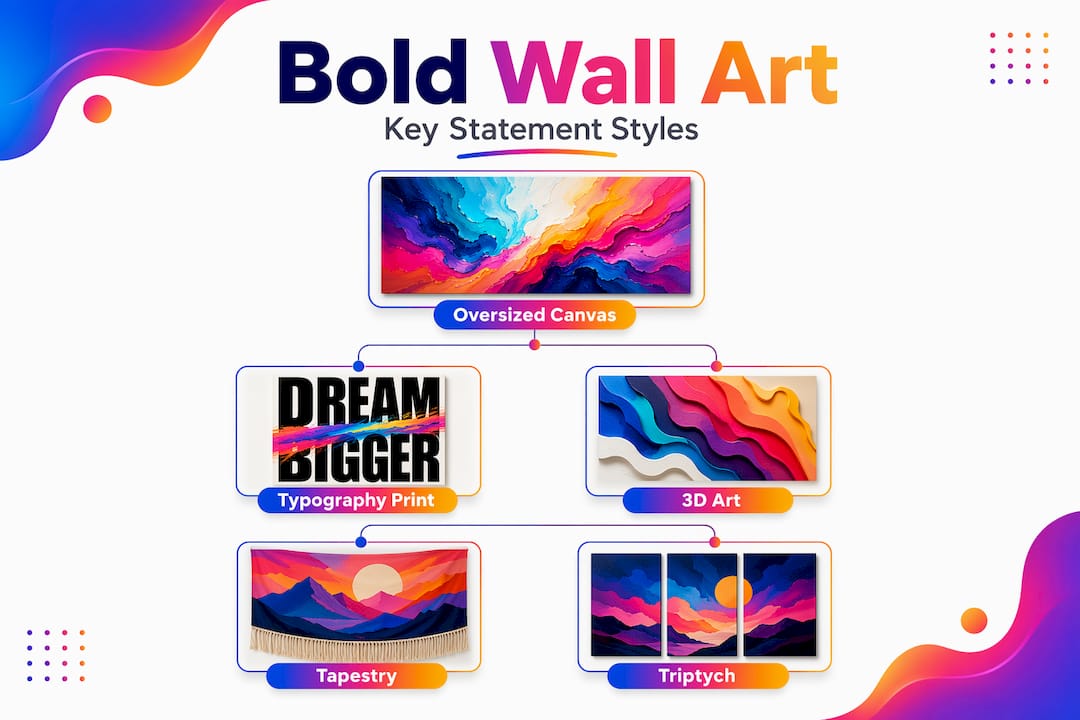
Typography prints are underused and underrated. A phrase, a single word, or even a song lyric printed at 40 inches wide carries enormous weight. The trick is choosing typography with strong contrast and a clean typeface. Ornate scripts at large sizes tend to look cluttered rather than bold.
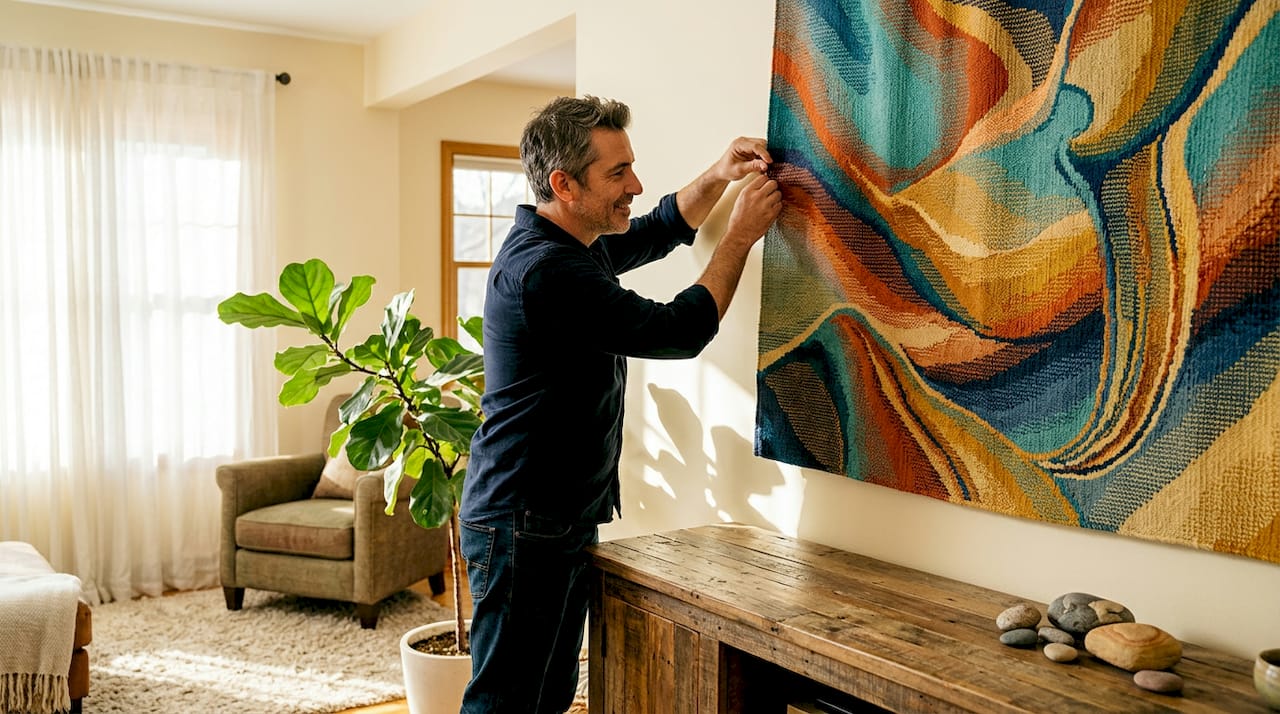
Textile wall art deserves special attention. Interior designers recommend tapestries above beds, behind seating areas, and in hallways to add texture alongside visual weight. What makes them useful is that boldness here comes from scale and texture together, not just color. A large woven piece in warm neutrals can be just as commanding as a neon print.
Pro Tip: Diptychs and triptychs work especially well on wide blank walls that a single canvas would leave feeling unfinished. Use them above a sofa or long console table to fill horizontal space intentionally.
How to choose bold wall art for your space
Choosing statement art is less about finding a piece you love and more about matching a piece to a room’s specific needs. Both matter. But the room has to be part of the equation from the start.
-
Measure your wall first. The most common decorating mistake is buying art that’s too small. For a sofa wall in a living room, the art should be roughly two thirds of the sofa’s width. For a large blank wall, think in terms of feet, not inches.
-
Map your color palette. Bold art can either complement or intentionally contrast your existing colors. A teal abstract in a gray and white room creates energy. A warm terracotta piece in the same room creates warmth. Neither is wrong. What’s wrong is choosing randomly without checking the relationship.
-
Consider the room’s purpose. Bedrooms benefit from pieces that feel personal and calming even when bold. Canvas prints are easy to customize and work well in any room, but the subject matter should reflect the room’s function. An aggressive geometric in jewel tones works in a living room. In a bedroom, the same energy might disrupt sleep.
-
Trust your emotional response. Statement art works because it creates emotional resonance. Homes staged with bold artwork sell 73% faster than those without, which tells you something about the psychological effect art has on people. Choose pieces that make you feel something specific, not pieces that are technically impressive but leave you cold.
-
Mix textures and formats deliberately. A flat canvas print in an all-smooth room can feel incomplete. Combining a large canvas with a smaller woven textile nearby adds depth. The vibrant wall art that really lands in a room usually has at least one textural element nearby to ground it.
Pro Tip: If you are stuck between two pieces, photograph your room and use your phone to mock up both options at scale using editing apps. Seeing the size relationship before you buy saves a lot of regret.
Styling and placement strategies
Even the right piece in the wrong spot loses its power. Placement is where most decorators leave results on the table.
Hanging height: The center of art should hang at 57 to 60 inches from the floor in most rooms. Drop that to 54 to 57 inches in dining rooms where seated sightlines matter. Above furniture, keep 6 to 8 inches of space between the bottom of the frame and the top of what’s beneath it.
Best wall locations for maximum impact:
- Entryways: The first thing guests see. A bold piece here sets the entire tone of your home.
- Above the sofa: The classic living room placement. Use a single large canvas or a triptych matched to roughly two thirds of the sofa width.
- Above the bed: A focal point that defines the bedroom’s personality. Textile tapestries and oversized canvas prints both work well here.
- Hallways: Underused. A series of bold photographic prints down a long hallway creates gallery energy without requiring a dedicated display space.
Lighting changes everything. Natural light brings out warm tones in the morning and shifts cooler by afternoon. Position bold pieces where they get even indirect light rather than direct sun, which fades colors over time. Add a picture light or directional track light above statement pieces to make them read consistently day and night.
3D wall art, including metal loops and woven forms, adds shadow play that flat prints cannot. In a room with simple geometry and minimal furniture, a three-dimensional piece often has more presence than a canvas twice its size. It’s worth exploring the canvas styling guide when considering how different formats interact with various room layouts.
Combining bold art with surrounding decor requires restraint. One statement piece per wall, or per visual zone, is the rule most designers follow. Pairing two competing focal points on the same wall splits the eye’s attention and weakens both.
My honest take on bold wall art
I’ve spent years looking at how people decorate their homes, and the pattern I see most consistently is fear. People choose art that’s too small, too safe, and too forgettable because they’re worried about getting it wrong. Then they wonder why the room never quite comes together.
What I’ve learned is that the rooms that feel most alive and personal always have at least one piece that took nerve to hang. A massive abstract in deep blue above the sofa. A stark black and white portrait in the hallway. A woven tapestry that fills an entire wall behind the bed. These are the choices people remember.
My advice is this: start with one bold piece in your highest-traffic room and let it lead the rest of the decorating decisions. Color-match your throw pillows to it. Choose furniture that gives it room to breathe. The art comes first. Everything else follows.
The other mistake I see constantly is buying art to match decor that already exists. That approach produces rooms that feel coordinated but lifeless. Bold art is supposed to create tension, not resolve it. A piece that challenges your room’s palette slightly is often what makes the space finally feel finished.
Investing in one strong statement piece matters more than covering every wall with smaller work. The benefits of bold wall art extend beyond aesthetics. A great piece changes how you feel in a room every single day you live in it.
— Shlomo
Transform your walls with Colormelt
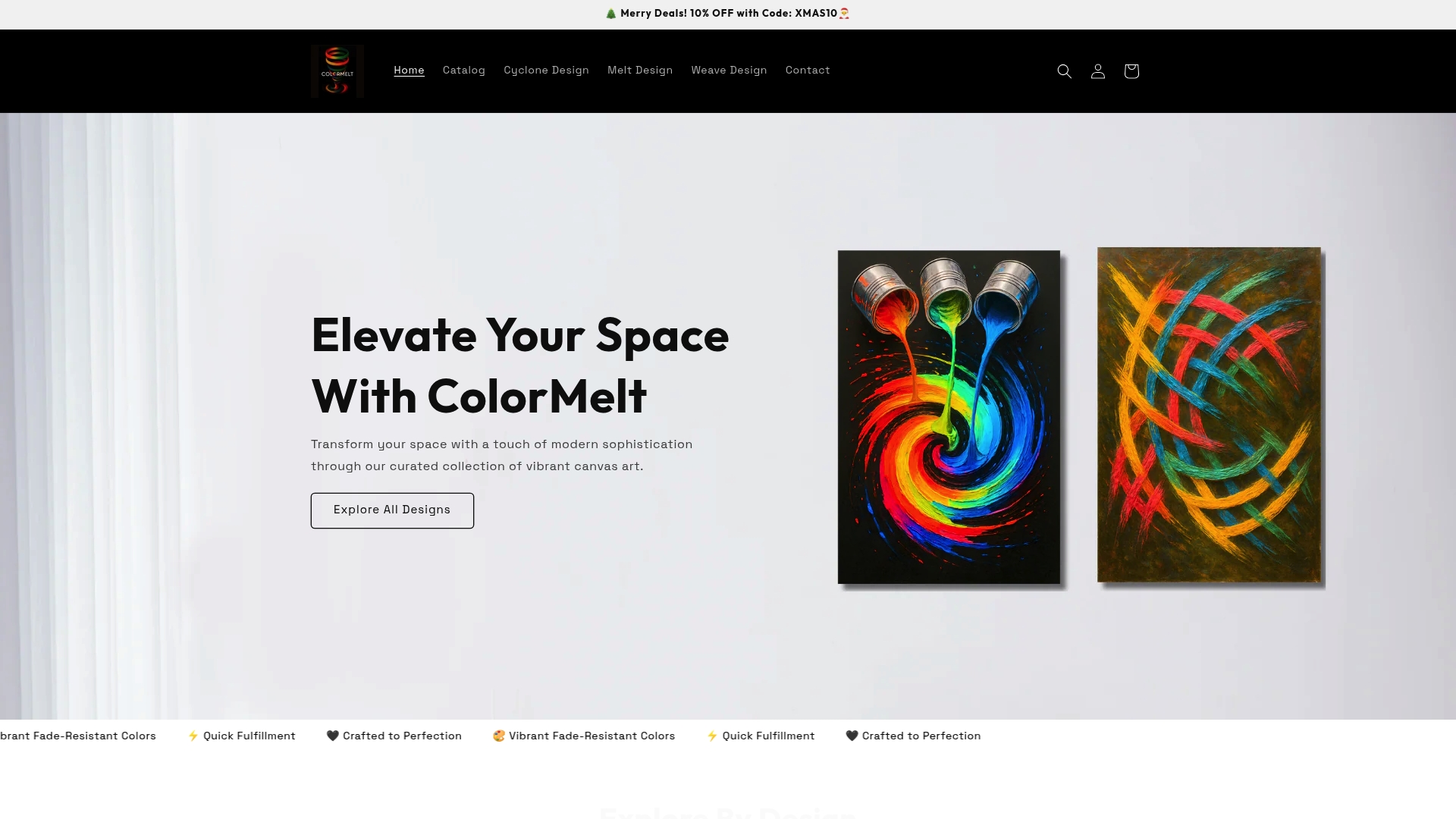
If this guide has you ready to make your move, Colormelt’s collection gives you the range to find exactly what your space is asking for. The bold wall art collection covers abstract canvases, striking prints, and textured wall hangings, all printed with fade-resistant inks that keep colors sharp for years.
Looking for something with dimension? The weave design wall hanging adds texture and warmth that flat prints can’t replicate. Want pure color energy? The cyclone design canvas brings the kind of saturated, high-contrast impact that anchors a room immediately. Every piece ships fast and arrives ready to hang. Start with one statement piece and let it do exactly what great art is supposed to do.
FAQ
What is bold wall art?
Bold wall art, also called statement art, is any artwork that commands visual attention through size, saturated color, sharp contrast, or a striking subject. A piece typically needs a minimum of 30 to 40 inches in one dimension to function effectively as a focal point.
Is bold wall art trendy or a lasting design choice?
Bold statement pieces have been central to interior design for decades, so they are not a passing trend. The specific styles change, but the principle of anchoring a room with a visually dominant piece remains a core design strategy.
How do I know if bold art will work in my room?
Measure your wall and check the two-thirds rule: art above a sofa should span roughly two thirds of the sofa’s width. Then consider your color palette and choose a piece that either complements or intentionally contrasts it.
Where is the best place for bold wall art in a living room?
The wall above the sofa is the most effective placement for bold wall art in a living room. Hang the center of the piece 57 to 60 inches from the floor and position it 6 to 8 inches above the back of the sofa.
Can bold wall art work in a small room?
Yes. A single oversized piece in a small room often makes the space feel larger and more intentional than filling the same wall with multiple smaller pieces. Keep surrounding decor minimal and let the art define the room.