
Why Collect Limited Edition Prints: Value and Joy
Limited edition prints are fixed-run artworks produced in a verified, numbered quantity that give collectors exclusive access to original artistic vision at a fraction of the cost of unique pieces. The practice of collecting art prints, specifically limited editions, sits at the intersection of emotional resonance and real investment logic. Scarcity, archival production standards, and documented provenance are the three pillars that separate a limited edition from a decorative poster. Whether you are building a serious collection or simply want art that means something on your wall, understanding why collect limited edition prints changes how you approach every purchase.
Why collect limited edition prints: the core value case
The single most compelling reason to collect limited editions is controlled scarcity. When an artist or publisher closes an edition at 50 or 100 prints, that number never changes. Smaller edition sizes command higher perceived value and collector demand than larger runs of 500 or more. That fixed supply, combined with growing demand as an artist’s career advances, creates the conditions for appreciation.
But scarcity alone is not enough. The factors that drive genuine collector value include:
- Edition size and closure. A run of 10 prints carries more weight than a run of 500. Once the edition closes, no additional prints can legally enter the market.
- Artist reputation and trajectory. An artist with gallery representation, museum acquisitions, or auction records at Christie’s, Sotheby’s, or Phillips creates demand that outlasts any single print.
- Archival production standards. Papers certified for 100+ year longevity typically weigh 200–300 GSM or more. Museum-grade prints start at 300 GSM to prevent degradation over time.
- Documentation. A certificate of authenticity, the artist’s signature, and a clear edition number are non-negotiable for serious collectors. Provenance records from galleries, publishers, or auction houses add another layer of confidence.
- Emotional engagement. Collectors motivated by emotional connection tend to hold limited editions longer than those driven purely by investment. That holding behavior itself supports long-term value.
“True value emerges when rarity is combined with institutional recognition of the artist’s career.” — Inside Arte
One misconception worth clearing up: artist’s proofs, often labeled A.P., are not automatically more valuable than standard numbered editions. Artist’s proofs hold value mostly if the numbered run is sold out, but they generally do not outperform standard editions. Chasing A.P. status without understanding the edition context is a common and costly mistake.
Pro Tip: When evaluating an edition, ask the gallery or seller whether the prints were produced in a single run or across multiple batches. Multiple printing batches can affect color consistency and long-term condition.

Limited edition vs. open edition prints: what is the difference?
Open edition prints are unlimited reproductions with no fixed supply ceiling. A publisher can reprint them indefinitely, which means open editions hold less exclusivity and long-term value compared to limited editions. They are often more affordable at entry, but that affordability reflects their unlimited availability.
The table below shows how the two formats compare across the attributes collectors care about most.
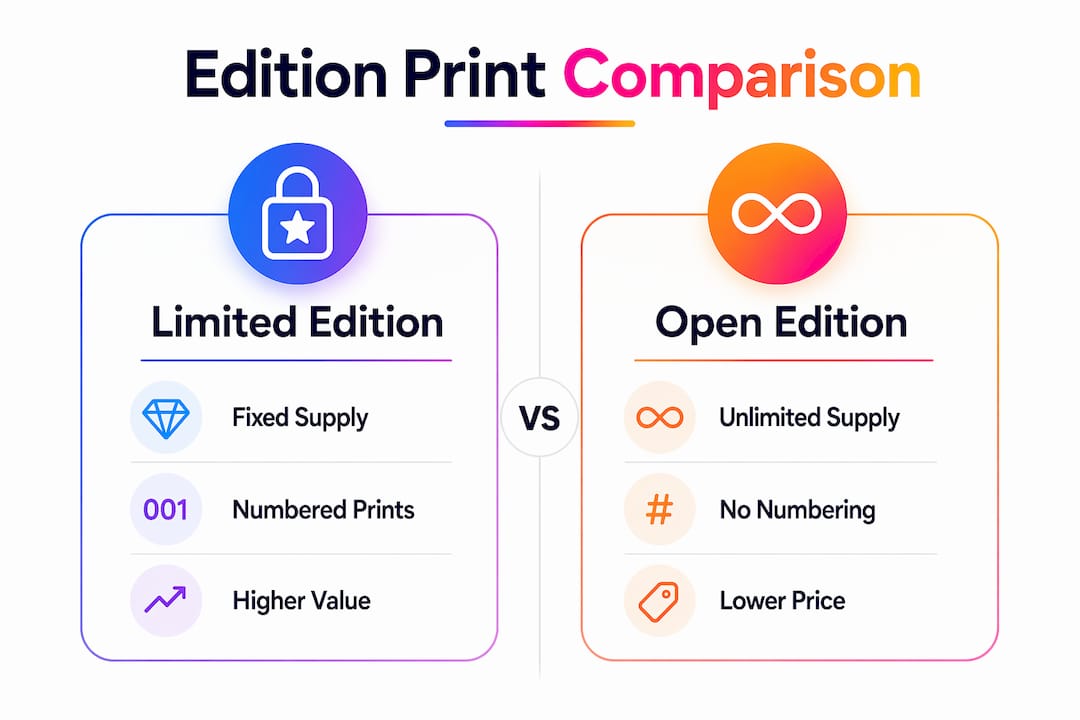
| Attribute | Limited Edition | Open Edition |
|---|---|---|
| Supply | Fixed, numbered, closed after print run | Unlimited, reprinted on demand |
| Exclusivity | High — each print is one of a finite set | Low — anyone can purchase at any time |
| Value trajectory | Can appreciate as artist career grows | Typically flat or declining over time |
| Documentation | Certificate of authenticity, signed, numbered | Usually unsigned, no edition number |
| Collector desirability | High for serious collectors | Primarily decorative market |
| Price point | Higher at purchase, reflects scarcity | Lower entry cost |
The pricing gap between the two formats is real, but so is the return profile. An open edition print from a well-known artist might cost $30 today and $30 in ten years. A limited edition from the same artist, closed at 75 prints, could appreciate significantly as the artist’s profile grows. The investment case for limited editions is not guaranteed, but the structural conditions for appreciation exist in a way they simply do not for open editions.
How to assess and choose high-quality limited edition prints
Choosing a limited edition print well requires more than liking the image. The following steps give you a repeatable framework for evaluating any print before you commit.
- Check paper weight. Aim for at least 300 GSM for museum-grade durability. Lighter papers yellow, warp, and degrade faster, which directly affects both the visual experience and resale value.
- Verify the signature and edition number. The artist’s hand-written signature and the fraction notation (e.g., 12/75) should appear on the print itself, not just on accompanying paperwork. If either is missing, treat it as a red flag.
- Request the certificate of authenticity. A credible certificate names the artist, the edition size, the print date, and the publisher or printer. Genuine scarcity requires signed, numbered prints backed by catalogue raisonné entries and credible provenance documentation.
- Confirm single-run printing. Ask whether the entire edition was printed at one time. Collectors should verify if limited editions were printed all at once or in separate batches, since multiple batches can affect color consistency and condition across the run.
- Research the artist’s market visibility. Look for gallery representation, auction records at dedicated print sales, and critical coverage. Auction houses like Christie’s, Sotheby’s, and Phillips run dedicated editions sales with print specialists who track exactly this kind of data.
- Understand the printmaking process. Process literacy about artist-printmaker collaboration is increasingly important for informed collecting. A screenprint, an etching, and a giclée are not equivalent. Each process carries different production costs, rarity implications, and collector perceptions.
Pro Tip: Lower edition numbers, such as 1/100, are not inherently more valuable than higher numbers like 87/100 unless the artist’s practice specifically dictates otherwise. Focus on the edition’s overall quality and documentation, not the number itself.
One more practical note: provenance matters as much as the print itself. A work acquired directly from the artist’s studio, a reputable gallery, or a major auction house carries a paper trail that protects your purchase. You can learn more about selecting quality wall art with lasting impact to build that evaluative eye before you buy.
What are the benefits of collecting limited edition prints?
The benefits of limited edition prints operate on two levels: personal and financial. Most serious collectors will tell you the personal level matters more, even when the financial returns are real.
On the personal side:
- Emotional storytelling. Every limited edition carries a narrative. The artist’s intent, the printmaker’s craft, and the moment of acquisition all become part of the object’s meaning. That story deepens your connection to the work over time.
- Exclusivity and personal prestige. Owning print 7 of 50 means fewer than 50 people in the world share that exact experience. That exclusivity is not vanity. It reflects a genuine relationship between collector and artwork that open editions cannot replicate.
- Access to renowned artists. A unique painting by a mid-career artist represented by a major gallery might cost $20,000 or more. A limited edition print from the same artist might cost $500 to $2,000. Limited editions democratize access to serious art without compromising on quality or authenticity.
- Building a meaningful collection. Collectors who personalize their spaces with art report stronger emotional connections to their environments. A curated wall of limited editions tells visitors something specific and intentional about who you are.
On the financial side, the value of limited edition art depends on the artist’s trajectory, edition size, and market conditions. None of these are guaranteed, but the structural case for investing in art prints is stronger for limited editions than for any other print format. The fixed supply means that as demand grows, prices can only move in one direction.
Key takeaways
Collecting limited edition prints delivers both personal meaning and measurable investment logic when you prioritize scarcity, archival quality, and verified provenance over surface-level appeal.
| Point | Details |
|---|---|
| Scarcity drives value | Fixed edition sizes create the supply conditions for long-term appreciation. |
| Documentation is non-negotiable | Always verify the artist’s signature, edition number, and certificate of authenticity before purchasing. |
| Paper quality determines longevity | Aim for 300 GSM or higher for museum-grade durability and color preservation. |
| Emotional connection matters | Collectors who buy what they love hold prints longer, which supports value retention. |
| Process literacy protects you | Understanding printmaking methods and single-run production helps you avoid overpriced or inconsistent editions. |
What fifteen years of collecting taught me about limited editions
I spent years chasing artist’s proofs because I believed the conventional wisdom that A.P. status meant superior value. It does not. What I eventually learned is that the numbered run itself tells you more about an edition’s integrity than any special designation. A well-documented, single-run edition of 50 prints on 300 GSM archival paper beats a poorly documented A.P. every time.
The editions market has become more transparent over the past decade. Platforms like MyArtBroker now publish auction histories and price data that were once accessible only to dealers. That transparency is good for collectors, but it also means there is no excuse for buying blind. If a seller cannot provide provenance, a certificate of authenticity, and printing details, walk away.
The most common mistake I see new collectors make is treating edition numbers as a proxy for quality. Print 1/100 is not better than print 87/100 unless the artist has specifically said so. What matters is the work itself, the production standards, and the artist’s standing in the market. Buy what genuinely moves you, document everything, and let the investment case follow from those fundamentals rather than drive them.
The collectors I respect most are not the ones with the most expensive pieces. They are the ones who can tell you exactly why they bought each work, who printed it, on what paper, and what the artist was doing at that moment in their career. That level of engagement is what separates a collection from a wall of decoration.
— Shlomo
Discover colormelt’s curated wall art collections
Colormelt brings together vibrant, archival-quality wall art designed for collectors who want their spaces to feel intentional and alive. Every piece in the collection is crafted with fade-resistant colors and durable materials, so what you hang today still looks sharp years from now.
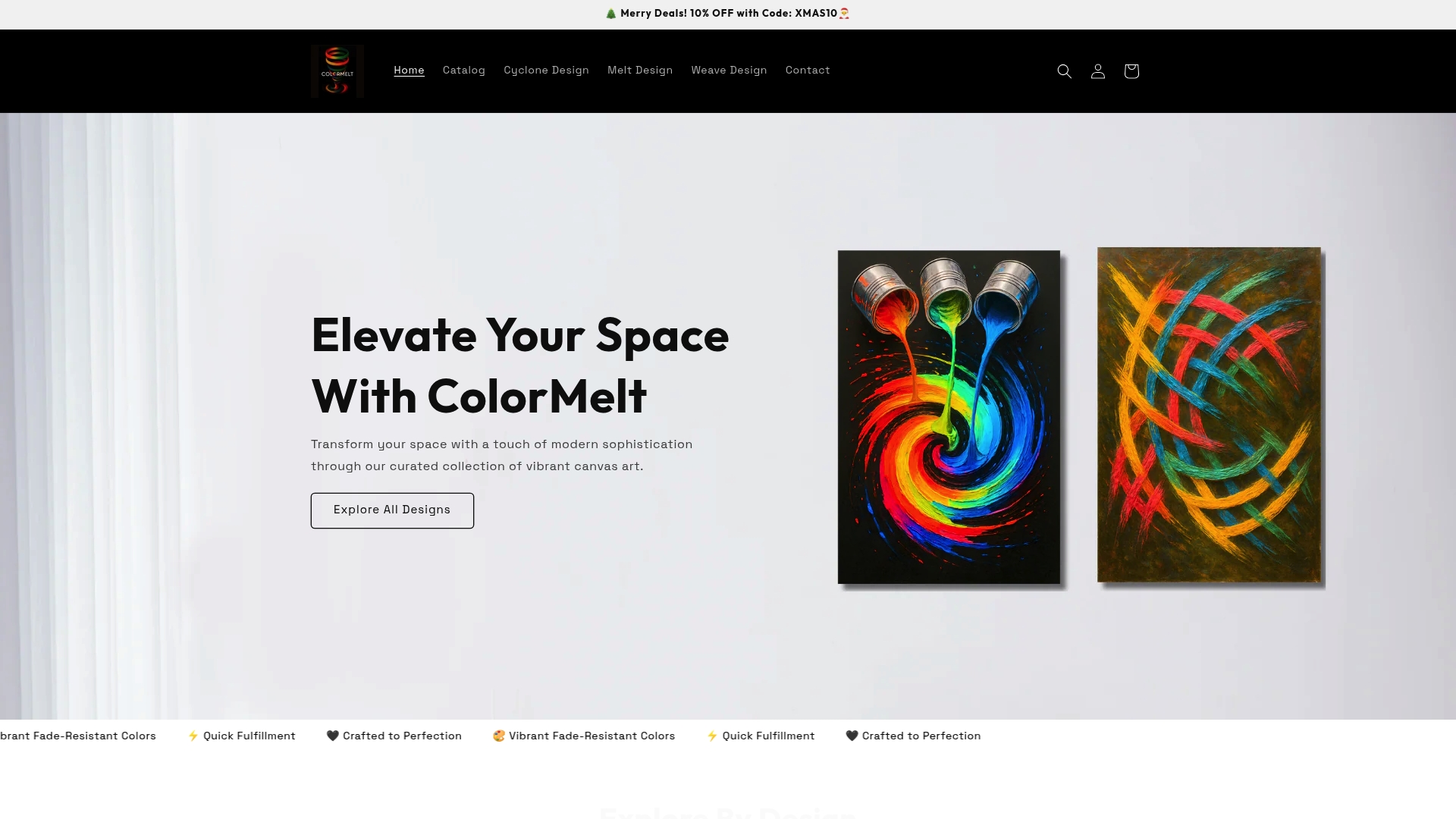
Whether you are drawn to bold abstract forms, intricate weave designs, or the kinetic energy of cyclone motifs, Colormelt’s wall art collection gives you a starting point for building a space that reflects your taste. For something truly distinctive, the Weave Design wall hanging offers a handcrafted quality that serious collectors will appreciate. Browse the full collection and find the piece that earns its place on your wall.
FAQ
What exactly is a limited edition print?
A limited edition print is an artwork produced in a fixed, numbered quantity, with each print signed and certified by the artist. Once the edition closes, no additional prints are made, which creates genuine scarcity.
Does a lower edition number mean a more valuable print?
Lower edition numbers are not inherently more valuable than higher ones. Edition numbers do not determine value unless the artist’s practice specifically assigns meaning to print order.
How do i verify a limited edition print is authentic?
Check for the artist’s hand-written signature, the edition fraction (e.g., 12/50), and a certificate of authenticity from the publisher or gallery. Provenance records from reputable sources add further confirmation.
Are limited edition prints a good investment?
Limited editions can appreciate in value as an artist’s career grows, particularly when edition sizes are small and documentation is strong. They offer a distinct liquidity profile compared to unique artworks, with dedicated auction sales at houses like Christie’s and Sotheby’s.
What paper weight should a quality limited edition print have?
Museum-grade limited edition prints use paper weighing at least 300 GSM. This weight supports physical durability, color stability, and longevity well beyond 100 years under proper storage conditions.