
Why invest in art prints: a homeowner's guide
Viewing original artwork reduces cortisol by 22% in about 20 minutes, according to a 2025 King’s College London study. That single fact rewrites the entire conversation about why invest in art prints. Most people frame it as a financial question, but the real case is more interesting: art prints occupy a rare category where the daily emotional return is immediate and measurable, while the financial return builds quietly in the background. This guide walks you through both sides, giving you the frameworks to choose prints that genuinely enhance your home and hold their value over time.
Table of Contents
- What makes art prints a smart investment choice
- Edition size, scarcity, and resale activity: keys to value
- The mental and aesthetic benefits of displaying art prints at home
- Practical tips for valuing and caring for your art print investment
- How to approach art prints as both décor and financial assets
- Why the traditional art investing mindset needs a refresh for prints
- Enhance your home with vibrant, investment-worthy art prints from ColorMelt
- Frequently asked questions
What makes art prints a smart investment choice
Art prints are not just decorative objects. They are a documented asset class with real pricing histories. Unlike a one-of-a-kind painting, a print exists in a series or numbered edition. That structure creates something valuable for investors: observable, repeatable transaction data.
Because the same edition prints repeatedly change hands, market pricing data emerges faster than it does for unique works. You can track what a specific print sold for in 2019, 2022, and again last year. That is a level of price transparency almost impossible to find in the unique art market.
That said, more data does not mean simpler decisions. Pricing can be noisy when editions trade frequently at varying auction houses. Understanding the difference between a print’s visibility in the market and its actual valuation requires looking at edition size, condition, provenance, and where the sales occurred.
Key reasons prints function as alternative investments:
- Repeat sale records allow price pattern analysis over time
- Edition structure creates built-in scarcity that drives demand
- Lower entry prices compared to unique works make them accessible to a broader range of buyers
- Tangible ownership provides something stocks and bonds do not: an asset you can live with
Exploring the types of art prints available, from screenprints to giclées, is a practical first step in understanding which formats carry more consistent market support.
Edition size, scarcity, and resale activity: keys to value
If there is one thing that separates a print worth buying from one that is purely decorative, it is the edition structure. Edition size tells you exactly how many copies exist. Smaller runs create stronger demand simply because fewer buyers can ever own one.
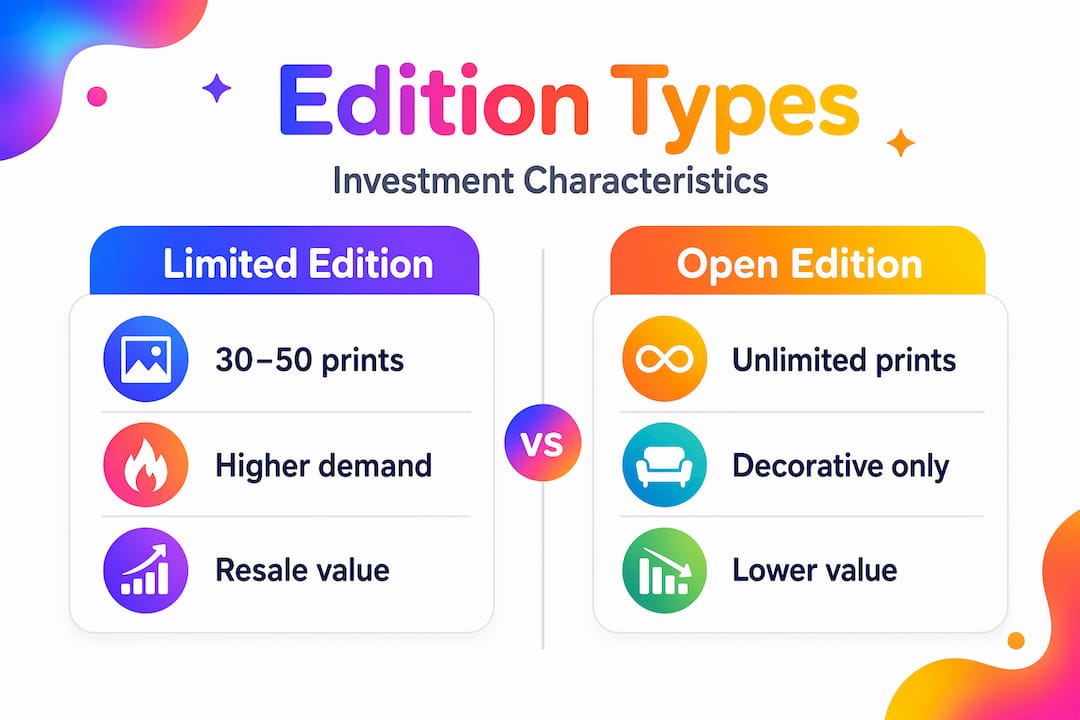
Prints produced in editions of 30 to 50 copies consistently attract more serious collector interest than open-edition reproductions. The math is simple: if 10,000 people want a print and only 40 exist, the market competition is real. Edition structure and liquidity together determine whether a limited edition print holds or grows in value over time.
Comparison: edition types and investment characteristics
| Edition type | Typical size | Scarcity level | Resale activity | Investment potential |
|---|---|---|---|---|
| Open edition | Unlimited | Low | Minimal | Primarily decorative |
| Standard limited edition | 100–500 | Moderate | Occasional | Moderate, artist-dependent |
| Small limited edition | 30–50 | High | Regular | Strong, with documentation |
| Artist’s proof (AP) | 10–15% of edition | Very high | Infrequent | High, condition-dependent |
Key signals that a limited edition print is likely to hold value:
- Consistent auction appearances showing multiple buyers over years, not a single spike
- Signed and numbered by the artist, ideally with a certificate of authenticity
- Published by a reputable print house with verifiable records
- Artist with an active or growing secondary market beyond the original sale
Choosing quality wall art starts with asking these questions before you buy, not after.
The mental and aesthetic benefits of displaying art prints at home
Here is something the investment conversation often skips: the return you receive every morning walking past a piece of art you love is real and measurable. The 22% cortisol reduction found in the King’s College London study holds even for reproductions, just less dramatically than for originals. For homeowners, that is a meaningful daily benefit from a single wall.
“Art is not what you see, but what you make others see.” That principle applies directly to your living space. The right print does not just fill a wall. It sets the emotional tone of the entire room.
Beyond stress reduction, art prints do something interior designers have known for decades: they anchor spaces. A bold abstract canvas in a neutral room creates instant focus. A vibrant floral print in a bedroom brings warmth without requiring a renovation. These are functional design outcomes, not just aesthetic preferences.
Regular exposure to art also helps interrupt mental loops. When your eye catches a complex, layered print, your brain briefly shifts processing from whatever you were ruminating on. That involuntary attention reset is genuinely useful on high-stress days.
Benefits of displaying quality art prints at home:
- Mood elevation through color psychology and visual stimulation
- Stress relief supported by measurable neurochemical responses
- Space personalization that expresses your identity without permanent changes
- Conversation and connection when guests respond to pieces you have chosen with intention
Pro Tip: Place art at eye level in rooms where you spend the most time sitting down, like a home office or living room. The viewing angle matters for both impact and enjoyment.
Explore art for well-being at home if you want to go deeper on how placement and subject matter affect mood in specific rooms.

Practical tips for valuing and caring for your art print investment
Buying a quality print is just the start. What you do after the purchase determines whether it holds its value over years or deteriorates quietly on your wall. Proper documentation and care are not optional extras. They are the foundation of a sensible art print investment guide.
- Secure all documentation immediately. Certificate of authenticity, edition number, artist signature, proof status, publisher details. Verifying these details is the first step any appraiser takes when valuing a print. Missing documentation can cut resale value significantly.
- Inspect condition regularly. Fading, foxing (small brown spots from moisture), and surface abrasions are the most common value-destroyers. Check twice a year, more often in humid climates.
- Use UV-protective glazing. Standard glass transmits light that fades ink and pigment over time. UV-filtering glass or acrylic is worth the extra cost on any print you paid more than a few hundred dollars for.
- Budget for true ownership costs. Insurance, transport, and storage add up and affect the real investment case. A print that appreciates 30% over a decade but cost 15% of its value in insurance and climate storage has not performed as well as the headline number suggests.
- Store unframed prints flat, acid-free. If you rotate your collection, flat files with acid-free interleaving tissue prevent creasing and chemical degradation.
- Document every resale offer you receive. Even if you do not sell, written offers establish a pricing floor and are useful for insurance purposes.
- Plan for a long horizon. Art prints are not liquid assets. Rushing a sale typically means accepting below-market prices.
Pro Tip: Photograph your print in natural light when you first receive it and store that image with your documentation. That original condition record protects you in any future insurance or resale conversation.
Thinking about how prints fit into your broader space? Personalizing your home with art covers practical styling strategies alongside ownership considerations.
How to approach art prints as both décor and financial assets
The smartest print collectors hold two filters at once: does this piece work on my wall today, and is there market evidence that it holds value over time? Letting one filter crowd out the other leads to problems. Pure financial logic produces sterile collections. Pure aesthetic enthusiasm can result in beautiful walls full of prints nobody else wants.
A practical framework for balancing both goals:
- Start with personal taste, then check the market. If you hate a print, owning it for investment reasons will feel like a chore. But if you love it and the edition data supports a strong market, that is the ideal combination.
- Diversify within your print collection. Different artists, styles, and edition sizes spread risk. A single artist’s entire catalog can fall sharply if their market cools.
- Use resale data, not opinions. Auction records and verified secondary market sales are more useful than gallery enthusiasm or social media hype.
- Treat prints as a long-horizon asset. Artworks typically come to market between 11 and 23 years after purchase, with no guaranteed return. Patience is not optional.
Comparison: art prints vs. other common investments
| Asset type | Liquidity | Enjoyment while held | Entry cost | Typical horizon |
|---|---|---|---|---|
| Stocks | High | None | Low | Variable |
| Real estate | Low | High (if owner-occupied) | High | 5–15 years |
| Limited-edition prints | Low to moderate | High (daily visual value) | Low to moderate | 10–23 years |
| Open-edition prints | Very low | High | Very low | Primarily decorative |
Use resources on choosing quality wall art alongside modern art decor tips to develop a selection process that satisfies both your design goals and your investment criteria.
Why the traditional art investing mindset needs a refresh for prints
Most of what gets published about art investment focuses on blue-chip paintings, auction house records, and Basquiat prices. That framing misleads print collectors badly. Prints are their own market with their own logic, and the conventional wisdom borrowed from unique art investing does not travel well.
The instinct many first-time buyers follow is to chase recognizable names or recent social media momentum. That is exactly the wrong approach. Disciplined evaluation of edition behavior matters far more than hype. A print from a moderately known artist with 20 years of consistent secondary market activity is a better investment bet than a viral print from a famous artist with almost no resale history.
The other myth worth challenging is the idea that art prints are either serious investments or just decoration. They are both, at the same time, and accepting that dual identity removes a lot of unnecessary confusion. When you buy a print that genuinely moves you, that you would happily own for 15 years even if it never appreciated, you have already aligned your expectations with how the market actually works.
Passion-led collecting with objective evaluation is not a compromise. It is the actual strategy that produces resilient collections. Understanding the full range of print types and their respective market dynamics is where that disciplined approach begins.
Enhance your home with vibrant, investment-worthy art prints from ColorMelt
Now that you have the framework for understanding why buy art prints and how to assess their value, the next step is finding pieces that genuinely deliver on both fronts: visual impact and quality you can trust.
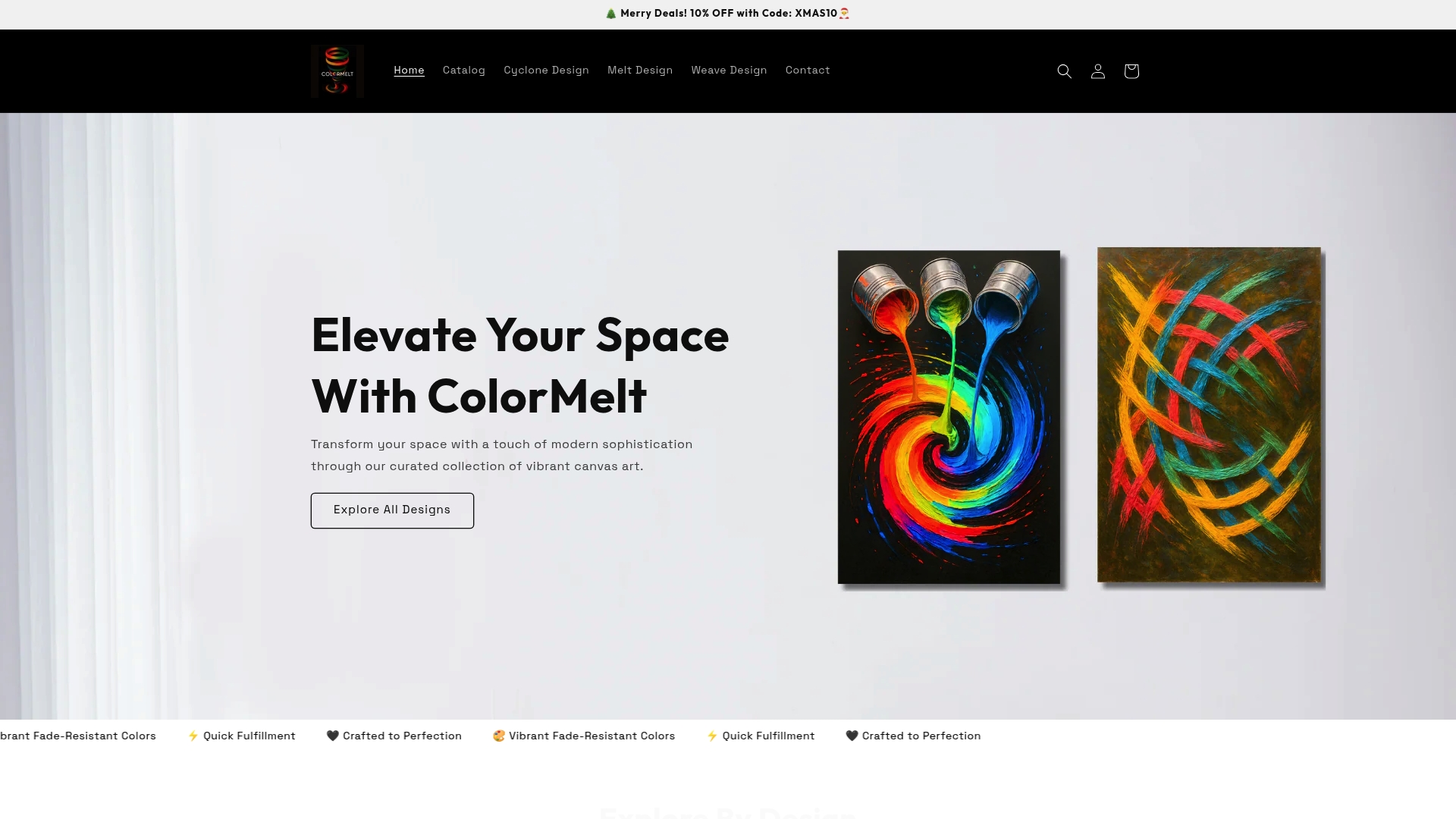
ColorMelt’s wall art collection brings together modern, vibrant designs built around real contrasts of color, texture, and form. Every piece uses fade-resistant pigments, meaning the investment quality you are protecting is matched by physical durability from day one. Browse the colorful abstract canvas print for a bold statement piece, or explore the vibrant art canvas print for a design that works across a wide range of interior styles. Quality craftsmanship and curated aesthetics in one place.
Frequently asked questions
What makes limited-edition art prints a good investment?
Limited-edition prints have a fixed supply and documented resale histories, making their value easier to assess and more likely to hold or grow when they trade in the secondary market regularly.
How does viewing art prints benefit mental health at home?
Viewing art prints can reduce cortisol levels by up to 22% in about 20 minutes, directly lowering stress hormones and supporting a calmer, more focused state of mind at home.
What costs should I consider beyond the initial purchase of art prints?
You should budget for insurance, climate-controlled storage, transport, and possible export licenses, as these full-cycle ownership costs directly affect the true return on your art print investment.
How long should I expect to hold art prints to see investment returns?
Art prints typically require 11 to 23 years on average before coming back to market, making them a long-horizon asset where patience and proper care are the most important factors.