
Why Curate Your Space: Design a Home That Works for You
Space curation is the intentional practice of selecting, arranging, and editing your home’s elements so every object reflects your personality and supports your daily life. This goes well beyond decorating. While decorating fills a room, curation edits it. Research shows that personalized environments boost productivity by up to 32% compared to bare, impersonal spaces. Understanding why curate your space matters means recognizing that your home is not just a backdrop. It is an active force shaping your mood, habits, and sense of self every single day.
What are the key benefits of curating your space?
Curating your environment delivers measurable psychological and functional advantages that generic decorating cannot match. The benefits of space curation reach far beyond aesthetics.
Mood and productivity lift. Enriched, personalized spaces improve performance and social interaction. Spaces that lack personal meaning actively reduce both. That is not a minor detail. It means the objects you choose to keep or remove directly affect how well you think and feel each day.

Reduced cognitive load. Clutter signals unfinished business to your brain. Visual noise elevates cortisol, the stress hormone, by constantly reminding you of tasks left undone. A curated room practices what designers call visual quieting: removing everything that does not serve a clear purpose or bring genuine joy.
Habit support. A curated space functions as a container for the life you want to live. When your environment is organized around your actual routines, positive behaviors become the default rather than the exception. You stop relying on willpower and start relying on your surroundings.
Mindfulness and alignment. Creating mindful spaces means every item earns its place by connecting to your values. A shelf with three meaningful objects communicates identity. A shelf crowded with thirty random items communicates noise.
- Every object either serves a function or brings genuine joy. Remove anything that does neither.
- Visual quieting prioritizes open space as a design element, not empty space to be filled.
- Personalized art and meaningful objects act as cultural anchors, reinforcing who you are.
- Curated lighting and texture layers create depth without adding clutter.
Pro Tip: Start your curation practice by removing items for one week before adding anything new. Subtraction reveals what your space actually needs.
How does space curation differ from traditional decorating?
Curation and decorating are not the same practice. Decorating is largely a one-time event: you furnish a room, hang some art, and call it done. Curation is continuous. It is an ongoing editing process where you regularly reassess whether each item still fits your identity and lifestyle.
Traditional decorating often aims for a complete, finished look. Curation deliberately avoids the showroom aesthetic. A curated home tells a story through intentional layering and balanced arrangement. Every object contributes to a larger personal narrative. Negative space and lighting are treated as design tools, not accidents.
The discipline of curation also lives in what you remove. Removing items that no longer fit is more important than adding new ones. Most people instinctively accumulate. Skilled curation requires the opposite instinct: restraint and regular editing.
Pro Tip: Walk into your room as if you are a guest seeing it for the first time. Note what draws your eye immediately. If it is clutter rather than a meaningful object, that is your first edit.
Texture layering is another key distinction. Decorating often treats surfaces as flat. Curation uses the 60-30-10 rule applied to texture: 60% neutral backgrounds, 30% secondary materials, and 10% accent objects. This creates visual depth without chaos. Neutral walls and floors become a backdrop that makes your personal objects stand out rather than compete.
Lighting follows the same logic. Curated rooms use lighting to direct attention, create warmth, and define zones. Decorating often treats lighting as an afterthought. Curation treats it as a primary layer, as important as any piece of furniture or art on the wall.
What steps can you take to begin curating your living space?
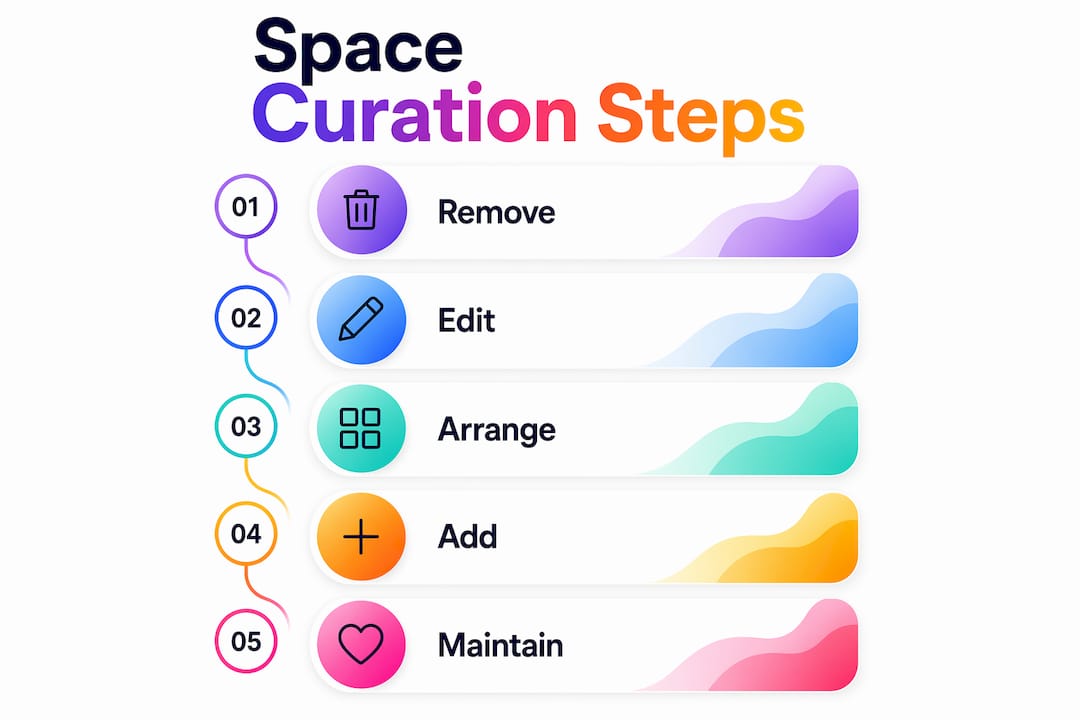
Space curation follows a continuous five-step process: lifestyle assessment, decluttering, layering textures, placing meaningful objects, and ongoing maintenance. Each step builds on the last.
-
Assess how you actually live. Before moving a single object, observe your daily patterns. Where do you drop your keys? Where do you read? Where do you feel most at ease? Your curation should serve your real life, not an idealized version of it. A guide to vibrant modern decor consistently emphasizes this point: design for the person you are, not the person you think you should be.
-
Declutter with visual quieting as your goal. Remove everything from a surface or shelf. Put back only what earns its place. Ask two questions for each item: Does it serve a function? Does it bring genuine joy? If the answer to both is no, it leaves. This is not minimalism for its own sake. It is making room for what actually matters.
-
Layer textures and lighting. Once surfaces are clear, build depth through material contrast. Pair smooth ceramics with rough linen. Combine warm wood tones with cool metal accents. Layering textures and lighting creates a finished feel that decorating alone rarely achieves. Add a floor lamp or directional light to anchor a reading corner. Good lighting makes every other element work harder.
-
Place meaningful objects with intention. Group objects in odd numbers, typically three or five, because asymmetry reads as natural rather than staged. Place items at varying heights to create visual movement. A piece of wall art, a small plant, and a single book create a composition. Twenty items on the same shelf create noise. Colormelt’s personalized wall art works particularly well as an anchor piece because it carries both color and personal meaning in a single object.
-
Maintain and edit regularly. Curation is never finished. Revisit your space every few months and ask whether each item still fits who you are. Life changes. Your space should change with it. Patience matters here. Resist the urge to fill gaps immediately. Empty space is not a problem to solve.
Pro Tip: When you bring a new object home, remove one existing item. This one-in-one-out rule keeps curation from sliding back into accumulation.
How does environment design influence daily habits and well-being?
Your environment shapes your behavior more reliably than your intentions do. Chaotic or outdated spaces drain mental energy and make positive habits harder to maintain. A curated space does the opposite: it makes good behavior the path of least resistance.
The mechanism is straightforward. Environment design places visual cues in your direct line of sight, nudging behavior automatically without conscious effort. A journal left open on your desk invites writing. A yoga mat unrolled in a clear corner invites movement. A bowl of fruit on the counter invites healthy eating. None of these require willpower. They work because the environment makes the right choice the obvious one.
This is why the importance of space design extends well beyond aesthetics. A well-arranged space is a habit system. It encodes your priorities into your physical surroundings so you do not have to re-decide them every morning.
- Place books where you want to read, not where they fit on a shelf.
- Keep creative tools visible and accessible if creativity is a priority.
- Remove screens from spaces you want to associate with rest or conversation.
- Use a single meaningful art piece to anchor the emotional tone of a room.
Biophilic design adds another layer. Incorporating natural materials, plants, and natural light connects your space to the outside world and reduces stress. The key is restraint. A few well-placed plants add calm. An overcrowded collection of greenery creates its own visual noise. The same editing principle applies: less, chosen well, always outperforms more, chosen carelessly. Learning how to style modern decor for warmth and cohesion follows this exact logic at every scale.
Key Takeaways
A curated space is not a decorated space. It is a living system that reflects your identity, supports your habits, and reduces the mental friction of daily life.
| Point | Details |
|---|---|
| Curation beats decorating | Curation is an ongoing editing process, not a one-time styling event. |
| Removal matters most | Removing items that no longer fit is more powerful than adding new ones. |
| Environment shapes behavior | Strategic object placement nudges positive habits without relying on willpower. |
| Visual quieting reduces stress | Clutter raises cortisol; clear, intentional spaces lower it and improve focus. |
| Personalization drives performance | Spaces with personal meaning improve mood and productivity measurably. |
What living with a curated home actually taught me
Most people approach curation as a project with a finish line. They declutter on a weekend, rearrange a few shelves, and expect the result to hold. It does not. The spaces that feel genuinely curated are the ones that get edited regularly, sometimes just a small adjustment, a different lamp position, one object removed from a shelf.
The hardest lesson I learned was that discipline in curation lives in removal, not addition. Every time I felt the urge to buy something new for a room, I forced myself to identify what would leave to make room for it. That friction alone stopped a lot of unnecessary purchases. The room got better by getting smaller.
The emotional payoff surprised me. Walking into a space where every object has a reason to be there creates a quiet confidence. The room does not demand your attention. It supports it. That is the difference between a space that drains you and one that restores you. Most people have never experienced the second kind because they have never committed to the editing required to get there.
Start with one surface. One shelf, one corner, one wall. Get that right before touching anything else. Patience is the actual skill here, not taste.
— Shlomo
Colormelt’s wall art collection for intentional spaces
Choosing the right art is one of the most direct ways to anchor a curated room. A single strong piece communicates more than a wall covered in smaller, unrelated frames.
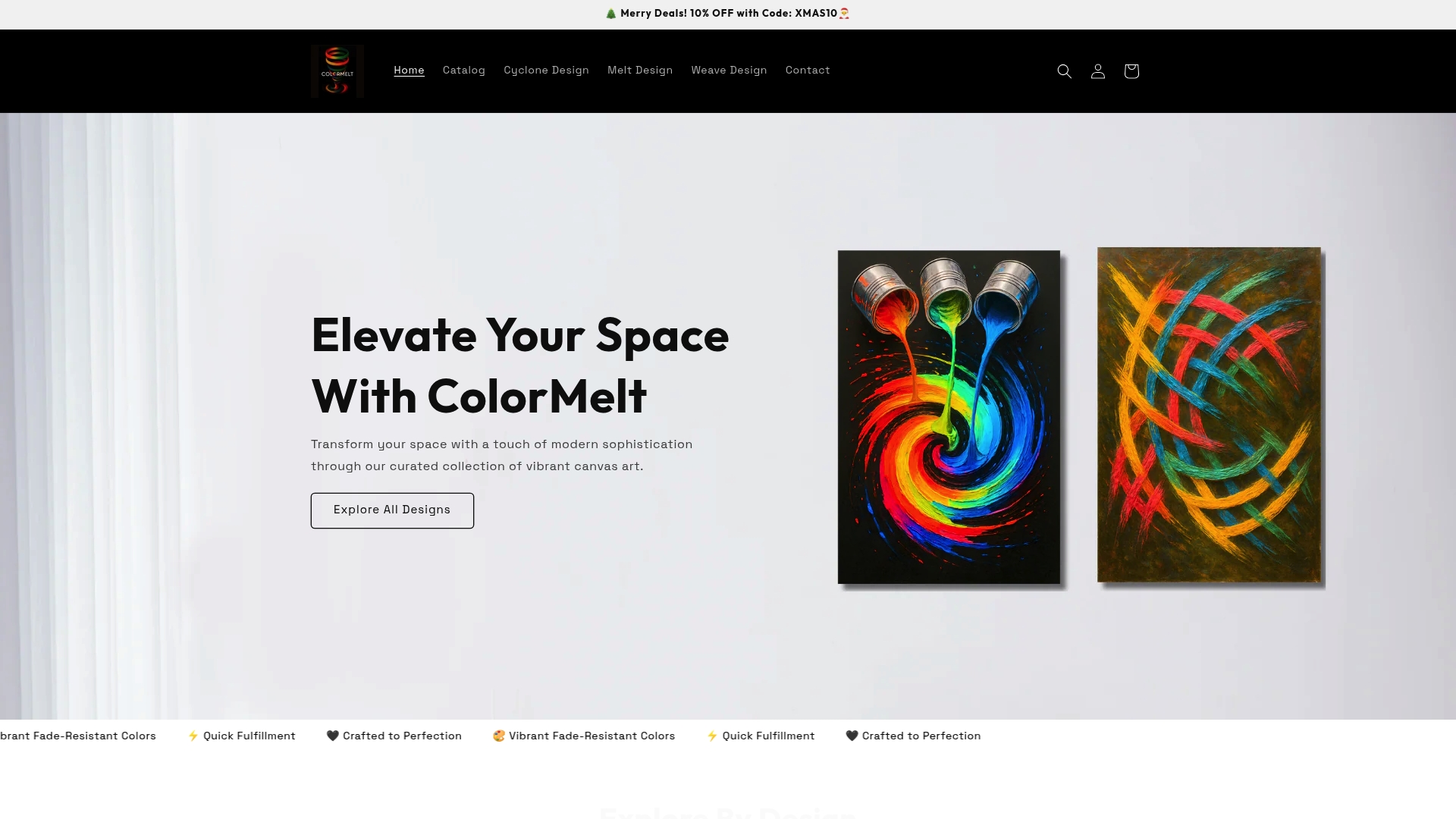
Colormelt’s wall art collection is built around exactly this idea. Each piece uses bold color contrasts and abstract forms to create a visual focal point that works with your existing space rather than competing against it. The fade-resistant canvas prints and acrylic options hold their color over time, so your investment in a curated look stays intact. For rooms that need a vibrant accent without visual clutter, the Cyclone design delivers movement and depth in a single piece. Browse the full collection and find the one object that earns its place on your wall.
FAQ
What does it mean to curate your space?
Curating your space means intentionally selecting and editing your home’s objects so each one reflects your personality and supports your lifestyle. It is an ongoing process, not a one-time decoration project.
How is curation different from just cleaning or organizing?
Cleaning removes dirt and organizing creates order, but curation goes further by asking whether each item belongs in your life at all. Curation is about meaning and identity, not just tidiness.
Can a curated space actually improve your mood?
Yes. Research links personalized, intentional environments to reduced cortisol levels and improved daily mood. Clutter signals unfinished work to your brain, while clear, meaningful spaces signal calm.
Where should I start when curating my home?
Start with one surface or one corner. Remove everything, then return only items that serve a function or bring genuine joy. Build outward from that single edited space.
How often should I revisit my curated space?
Revisit and edit your space every few months. Your identity and habits evolve, and your environment should reflect those changes rather than freeze a version of you from the past.