

Home Gallery Definition: Design, Meaning, and Setup
A home gallery is defined as a curated residential space designed to display art and meaningful objects with intentional lighting, spatial rhythm, and a clear editorial point of view. This concept goes well beyond hanging a few frames on a wall. The full home gallery meaning encompasses what designers call a “micro-gallery” or Gallery House: a living environment where daily life and museum-quality presentation coexist. Understanding the definition of home gallery helps you move from random decoration to a space that tells a real story. Colormelt’s collections are built precisely for this purpose, offering vibrant, fade-resistant prints suited to gallery-level display.
What is the definition of a home gallery?
A home gallery is a micro-gallery that merges daily life with professional presentation through intentional lighting, circulation paths, and curatorial narrative. That definition separates it from a simple decorative wall. The key word is “curatorial.” Every piece in a home gallery earns its place because of what it contributes to the overall story, not just because it fills space.
The concept also appears under the term “Gallery House,” which treats the home as a living exhibition where art and daily life coexist through calibrated wall surfaces, sightlines, and natural light. This architectural philosophy is gaining traction as homeowners prioritize atmosphere and proportion over pure decoration. The result is a space that functions like a private museum while remaining fully livable.
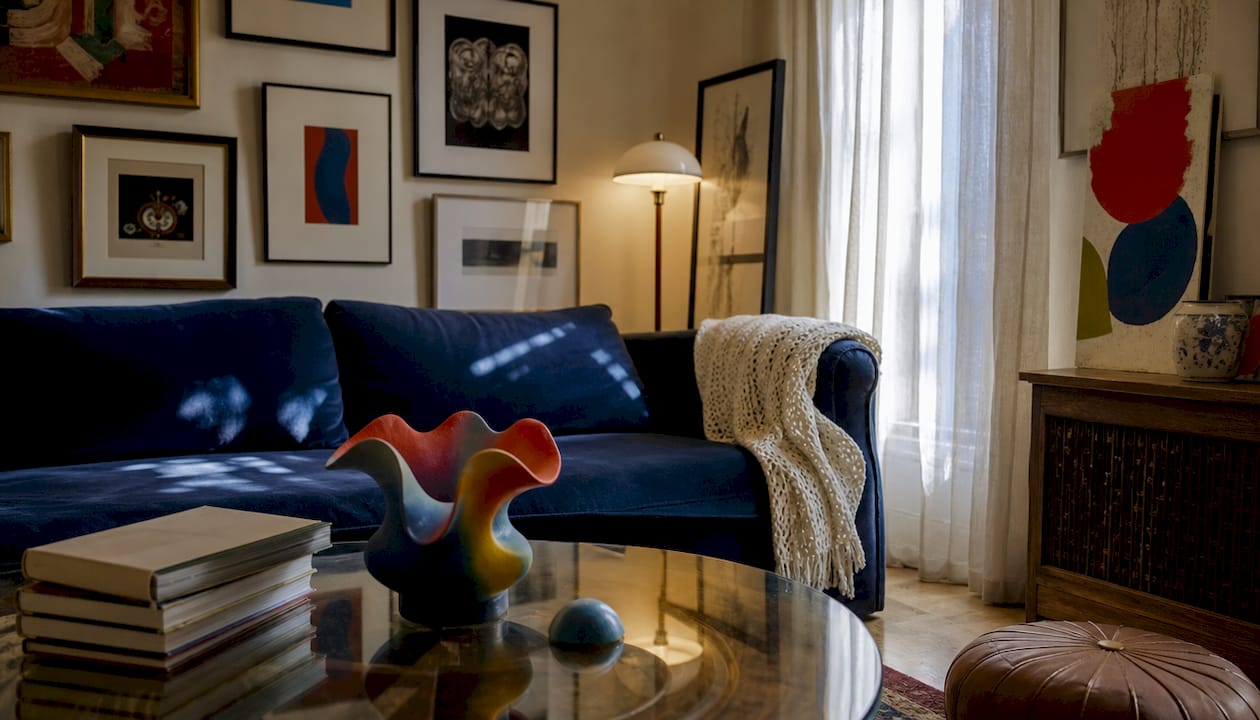
Three elements define a true home gallery. First, a curatorial point of view: every piece connects to a theme, palette, or personal narrative. Second, intentional lighting that reduces glare and draws attention to individual works. Third, spatial rhythm, meaning the deliberate pacing of objects across a room so the eye moves naturally from one piece to the next.
How does a home gallery differ from a traditional gallery wall?
A gallery wall and a home gallery are related but not the same thing. A standard gallery wall is a curated collection of framed art, photos, or objects arranged on a single wall with consistent spacing of 2–3 inches between frames. The industry standard hanging height is 57–60 inches from the center of the frame to the floor. That standard exists to align with average eye level, making viewing comfortable without effort.
A home gallery operates at a larger scale and with greater intention. Where a gallery wall is a single composition, a home gallery considers the entire room or even multiple rooms as the exhibition space. Circulation paths matter. You plan where a viewer enters, what they see first, and how they move through the space. Dead ends and cluttered sightlines break the experience.
Operational features also separate the two concepts:
- Curatorial narrative: A home gallery has a theme or story arc. A gallery wall may simply group items by color or size.
- Lighting design: Home galleries use museum-grade or adjustable lighting to highlight individual works. Gallery walls often rely on ambient room light.
- Circulation planning: Home galleries account for how people move through the space. Gallery walls are static compositions viewed from one position.
- Stewardship systems: True home galleries use digital cataloguing and climate control to preserve collections over time.
Pro Tip: Before hanging a single frame, walk through your space and identify the natural sightline from each entry point. That first view should anchor your strongest piece.
What are the main styles for home gallery design?
Designers recognize three primary frameworks for home gallery design. Each one shapes frame selection, color palettes, and the emotional atmosphere of the space. Choosing the right framework before you buy a single piece saves significant time and money.
| Style | Core Characteristics | Best For |
|---|---|---|
| Modern | Minimalist layouts, monochrome or limited palettes, clean frames | Collectors who want art to speak without visual competition |
| Vintage | Mixed eras, ornate frames, warm tones, layered textures | Spaces that tell a multigenerational or travel-based story |
| Eclectic | Balanced blend of styles, varied frame materials, bold color accents | Homeowners with diverse collections who want cohesion through color |
These three frameworks communicate personal narratives in residential environments. The framework is not a rigid rule. It is a filter. When you know your style, every purchasing decision becomes faster because you have a clear standard to measure against.
Modern home galleries favor negative space. Fewer pieces, more breathing room between them. Vintage galleries layer depth through texture and patina. Eclectic galleries succeed when one unifying element, usually a color or material, ties otherwise different pieces together. For ideas on how current trends intersect with these frameworks, Colormelt’s wall art trends guide covers the styles gaining the most traction in 2026.
What are the best practices for setting up a home gallery?
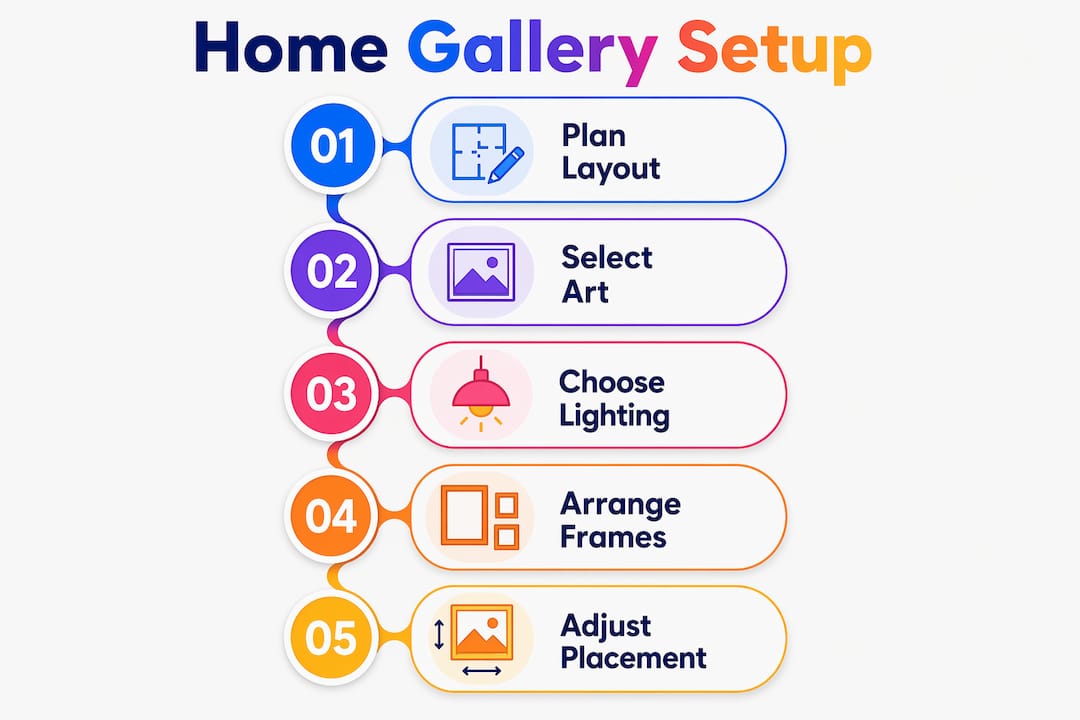
Setting up a home gallery effectively requires decisions in a specific order: wall color first, lighting second, layout third, and curation last. Reversing that order is the most common mistake.
-
Choose neutral wall colors. Neutral tones like white, beige, and soft gray prevent the wall from competing with the artwork. Dark or patterned surfaces pull attention away from the pieces and flatten the visual hierarchy. This is the single most impactful decision you make before hanging anything.
-
Plan your lighting. Natural light is the preferred base for home galleries, complemented by adjustable artificial options. Track lighting or picture lights give you control over direction and intensity. Avoid overhead fixtures that cast flat, shadowless light across the entire wall.
-
Map your layout before drilling. Use paper templates or painter’s tape to test arrangements on the wall. Maintain consistent spacing between frames, typically 2–3 inches, to create visual order without rigidity.
-
Design for circulation. Visitor flow should feel intuitive, with no dead ends and clear focal points that guide the eye. Even in a single room, the sequence in which someone encounters your pieces shapes how they interpret the collection.
-
Build a stewardship system. Photograph every piece, record its dimensions and provenance, and store that information digitally. Simple climate awareness, keeping humidity and direct sunlight in check, extends the life of canvas and paper prints significantly.
Pro Tip: Hang your largest or most visually dominant piece at the natural focal point of the room, not necessarily the largest wall. Focal points are determined by sightlines, not square footage.
For a detailed walkthrough of arrangement techniques, Colormelt’s wall art arrangement guide covers balanced layouts with practical examples.
How can a home gallery serve personal and emotional functions?
A home gallery functions as a personal museum, and that distinction carries real weight. Displaying travel artifacts, portraits, and milestones increases both property appeal and emotional resonance. The objects you choose to display communicate your values, your history, and your aesthetic sensibility to everyone who enters the space.
The emotional value of a home gallery is distinct from its decorative value. A framed print adds color to a wall. A curated collection of prints, photographs, and objects tells a story that a visitor can read. That narrative function is what makes a home gallery meaningful rather than merely attractive.
“A successful home gallery tells a story through context, displaying process and archives alongside finished works for a richer, more layered experience. The emotional value lies in its function as a personal museum, making a home genuinely unique and meaningful.”
Home galleries also serve a legacy function. When you catalog your collection and display it with intention, you create an archive that outlasts the moment. Future residents, family members, or guests encounter not just objects but a record of a life lived with attention to beauty and meaning. That is a fundamentally different outcome than a wall covered in decorative prints chosen for color alone.
Key Takeaways
A home gallery is defined by curatorial intention, professional lighting, and spatial rhythm. It is not simply a gallery wall at larger scale. It is a living exhibition environment that tells a personal story through every object it contains.
| Point | Details |
|---|---|
| Core definition | A home gallery is a curated residential space with intentional lighting, circulation, and a clear editorial narrative. |
| Gallery wall vs. home gallery | Gallery walls are single-wall compositions; home galleries treat entire rooms as exhibition environments. |
| Style framework matters | Choosing Modern, Vintage, or Eclectic before purchasing guides every design decision that follows. |
| Neutral walls are non-negotiable | White, beige, or soft gray walls prevent visual competition and create a professional gallery look. |
| Stewardship extends value | Digital cataloguing and basic climate awareness preserve your collection and its legacy over time. |
Why most home galleries fall short of their potential
Most people stop at the gallery wall and call it a home gallery. I understand why. The gallery wall is satisfying. It fills a space, adds color, and feels intentional. But after spending years studying how curated residential spaces actually function, I am convinced that the gap between a gallery wall and a true home gallery is not about budget. It is about systems.
The homeowners who create genuinely memorable gallery spaces treat curation as an ongoing practice, not a one-time project. They revisit their collections. They rotate pieces. They think about what a visitor sees in the first three seconds after entering a room. That operational mindset is what separates decoration from exhibition.
The other overlooked element is lighting. Most people install art, then light the room. The sequence should be reversed. Light the wall first, then hang the art. When you understand where your light falls, you know exactly where your strongest pieces belong.
I also think people underestimate how much a single wrong piece disrupts an otherwise coherent collection. A home gallery is not a place for every piece you love. It is a place for every piece that serves the story you are telling. That requires editing, and editing requires a clear point of view before you start.
— Shlomo
Colormelt’s wall art collection for your home gallery
Building a home gallery starts with finding pieces that carry visual weight and hold up over time. Colormelt’s curated wall art collection offers canvas prints, framed artwork, acrylic prints, and metal wall art in abstract, weave, cyclone, and floral designs. Every piece is produced with fade-resistant colors and built for long-term display, which matters when you are investing in a collection rather than seasonal decoration.

Whether you are starting with a single statement piece or filling out an eclectic gallery, Colormelt’s range covers Modern, Vintage-adjacent, and bold Eclectic styles. The Melt Design framed canvas works particularly well as a focal point in minimalist gallery arrangements. For room-specific styling ideas that connect directly to home gallery setup, Colormelt’s canvas print styling guide is a practical next step.
FAQ
What is a home gallery in simple terms?
A home gallery is a curated residential space where art and meaningful objects are displayed with intentional lighting, spatial rhythm, and a clear narrative. It functions like a private museum within a livable home environment.
How many pieces do you need for a home gallery?
There is no fixed number. A home gallery is defined by curatorial intention, not quantity. Three well-chosen, well-lit pieces with consistent spacing can constitute a home gallery more effectively than thirty randomly arranged prints.
What wall color is best for a home gallery?
Neutral tones like white, beige, and soft gray are the standard choice. These colors prevent the wall from competing with the artwork and create the clean visual field that makes individual pieces stand out.
What is the difference between a gallery wall and a home gallery?
A gallery wall is a single-wall arrangement of framed art with consistent spacing. A home gallery treats an entire room or multiple rooms as an exhibition environment, incorporating lighting design, circulation planning, and a curatorial narrative.
Do home galleries increase property value?
Curated home galleries increase emotional resonance and property appeal by telling a personal story through displayed objects and art. The direct financial impact varies by market, but well-designed gallery spaces consistently make a stronger impression on buyers and visitors.