
Types of Decorative Prints: Your Complete Style Guide
Types of decorative prints are the various artistic reproduction methods that transform images into wall art, each delivering unique texture, color clarity, and style compatibility. From giclée prints rendered at a minimum 1200 dpi to canvas prints stretched over wood frames, the medium you choose shapes how a room feels as much as the image itself. Whether you’re decorating a home office, a living room, or a commercial space, understanding print types helps you buy with confidence and decorate with intention. This guide covers every major print category, explains what makes each one distinct, and tells you exactly where each type works best.
1. What are the types of decorative prints?
Decorative prints fall into two broad categories: fine art reproduction methods and photographic or digital output methods. Fine art methods include giclée, lithography, screen printing, and etching. Digital and photographic methods include canvas prints, metal prints, acrylic prints, and C-type prints. Each category serves a different aesthetic goal and suits different room types. Knowing which category fits your space is the first decision you need to make.

2. Giclée prints: the gold standard for fine art decor
Giclée prints achieve sharpness through a minimum 1200 dpi inkjet process on archival paper or canvas. That resolution produces colors and details that closely match the original artwork, which is why galleries and collectors favor this format above all others.
Giclée is the preferred method for reproducing paintings, digital art, and fine art photography. The archival inks resist fading for decades, making giclée a sound long-term investment for any wall.
Key qualities that set giclée apart:
- Resolution: Minimum 1200 dpi produces museum-level sharpness
- Color fidelity: Pigment-based inks match original artwork tones accurately
- Substrate options: Archival paper, cotton rag, or canvas
- Longevity: Archival materials resist yellowing and fading for generations
- Use case: Ideal for fine art reproductions, limited editions, and collector pieces
Pro Tip: Select cotton rag or museum-quality paper over standard photo paper. The heavier substrate holds ink more evenly and gives the print a tactile quality that elevates the finished piece.
3. How canvas prints transform a space with texture and depth
Canvas prints create textured, three-dimensional appeal by printing art on canvas stretched over wood frames. That tactile surface adds warmth and artistic presence that flat paper prints simply cannot replicate.
Canvas prints are among the most popular choices for home decor because of their versatility and ready-to-hang convenience. They work across a wide range of interior styles, from farmhouse and traditional to contemporary and minimalist. The texture softens the image slightly, which suits landscapes, portraits, and abstract art particularly well.
Canvas prints also offer practical advantages. They arrive ready to hang, require no additional framing cost, and hold up well in rooms with moderate humidity. For decorators working with a budget, canvas delivers strong visual impact at a reasonable price point.
- Texture: Woven surface adds depth and warmth to any image
- Framing: Gallery-wrapped edges eliminate the need for a separate frame
- Style range: Suits traditional, modern, boho, and Scandinavian interiors
- Size flexibility: Available from small accent pieces to large statement panels
- Maintenance: Dust easily with a dry cloth; no glass to clean
Pro Tip: Match the frame depth to your room’s scale. A 1.5-inch deep gallery wrap reads well in large rooms. A 0.75-inch wrap suits smaller spaces and gallery wall arrangements.
4. What makes metal and acrylic prints ideal for modern decor?
Metal and acrylic prints deliver the highest color vibrancy of any print format. Metal prints use aluminum sheets infused with dye sublimation inks, producing exceptional color vibrancy favored in commercial and modern residential environments. Acrylic prints mount the image behind a sheet of plexiglass, creating a luminous, glass-like finish that makes colors appear to glow.
Both formats share key strengths: glossy surfaces, high contrast, and strong durability. They resist moisture, which makes them suitable for bathrooms, kitchens, and outdoor-adjacent spaces where paper prints would warp or fade.
| Feature | Metal prints | Acrylic prints |
|---|---|---|
| Surface finish | Matte or glossy aluminum | High-gloss plexiglass |
| Color vibrancy | Very high, warm tones | Extremely high, cool luminosity |
| Moisture resistance | Excellent | Excellent |
| Best decor style | Industrial, modern, commercial | Contemporary, minimalist, gallery |
| Weight | Lightweight | Moderate |
| Ideal rooms | Kitchen, bathroom, office | Living room, hallway, studio |
Both formats complement industrial, modern, and minimalist decorating schemes. If your space uses clean lines, neutral tones, and hard surfaces, either format will anchor the room without competing with the architecture.
5. Which traditional print methods add artistic authenticity?
Traditional print methods carry a handmade quality that digital formats cannot fully replicate. Each method leaves a physical mark on the substrate, giving the finished piece a presence that collectors and design-conscious decorators recognize immediately.
Lithography remains a revered traditional print method valued for vibrant colors and fine detail in limited edition art reproductions. Collectors and galleries favor lithographs for their artistic authenticity and the limited runs that make each print genuinely scarce.
Screen printing uses layered inks pushed through stenciled mesh screens to produce bold, graphic, and tactile art with vivid colors and texture. This method suits paper, fabric, and wood, creating statement pieces that anchor modern and eclectic interiors. The layered ink builds a slight relief on the surface, giving screen prints a texture you can feel with your fingertips.
Etching produces images through engraved metal plates pressed onto paper. The result is fine line detail and subtle tonal variation that suits traditional, academic, and vintage-inspired interiors. Etching works particularly well in studies, libraries, and formal dining rooms.
C-type prints deliver superior photographic color fidelity and tonal range, making them the preferred format for high-quality photo wall art. These are commonly used for photography prints in home and commercial spaces where accurate color reproduction matters most.
6. How to match decorative print styles to room function
Matching your print type to the room’s function prevents visual clutter and creates a space that feels intentional. Experts recommend matching print style to room function: minimalist line art suits modern spaces to reduce clutter, while watercolor and oil styles add warmth to traditional or boho interiors. That principle applies to the print medium as well as the image itself.
Use these guidelines to narrow your choices:
- Living room: Canvas prints and giclée reproductions work well. Large abstract or landscape pieces create a focal point without overwhelming the space.
- Home office: Metal or acrylic prints add energy and focus. Bold graphic screen prints motivate without distracting.
- Bedroom: Soft watercolor-style giclée or canvas prints promote calm. Avoid high-contrast metal prints, which can feel too stimulating for sleep spaces. Colormelt’s bedroom wall art ideas offer practical starting points for this room.
- Kitchen and bathroom: Metal prints resist moisture and clean easily. Acrylic prints work equally well in these rooms.
- Hallway: A curated gallery wall of mixed print types creates visual interest in a transitional space.
Large statement prints or curated gallery walls create more visual impact and reduce noise compared to smaller scattered prints. Prioritizing size and arrangement anchors room design far more effectively than filling every wall with small pieces.
Pro Tip: Before buying, tape paper cutouts to the wall in the intended print size. Live with the scale for a day. You will almost always discover that the print you planned to buy is smaller than the wall actually needs.
Color palette coordination matters as much as print type. Pull one or two colors from the print and repeat them in soft furnishings or accessories. That repetition ties the art to the room rather than leaving it floating on the wall. Colormelt’s guide on how to choose wall art walks through this process in detail.
For modern and minimalist rooms, modern home decor principles consistently favor fewer, larger pieces over many small ones. One well-chosen 40-by-60-inch canvas print reads more powerfully than six small prints arranged in a grid.
Key takeaways
The most effective approach to decorating with prints is to match the print medium to the room’s function, scale, and existing color palette before choosing any image.
| Point | Details |
|---|---|
| Giclée for fine art | Use giclée at minimum 1200 dpi on archival paper for collector-quality reproductions. |
| Canvas for versatility | Canvas prints suit nearly every interior style and arrive ready to hang. |
| Metal and acrylic for impact | Both formats deliver high vibrancy and moisture resistance for modern or commercial spaces. |
| Traditional methods for authenticity | Lithography, screen printing, and etching add handmade texture that digital formats cannot replicate. |
| Scale over quantity | One large statement print anchors a room more effectively than multiple small pieces. |
Why I think most people choose the wrong print medium first
Most decorators start with the image and then pick whatever format is cheapest or most familiar. That approach produces rooms that feel assembled rather than designed. I have seen it repeatedly: a beautiful photograph printed on thin paper, framed in a generic black frame, hanging in a room that needed the luminosity of an acrylic print. The image was right. The medium was wrong. The room never quite worked.
The medium carries as much visual weight as the image. A giclée print on cotton rag communicates permanence and seriousness. A screen print on wood communicates warmth and craft. An acrylic print communicates energy and precision. When the medium matches the room’s character, the art feels inevitable rather than decorative.
I also think people underestimate scale. A print that looks large in a product photo often disappears on a real wall. The paper cutout test I mentioned earlier sounds tedious, but it has saved me from buying undersized art more times than I can count. Scale is the variable that separates a room that looks finished from one that looks like it still needs something.
My honest recommendation: choose the medium first, then the image, then the size. Work in that order and you will make far fewer mistakes.
— Shlomo
Colormelt’s wall art collection for every print style
Colormelt carries a curated selection of wall art prints spanning canvas, acrylic, and wood formats, with designs ranging from bold abstract cyclone patterns to intricate weave motifs. Every piece ships with fade-resistant inks and arrives ready to hang, so you spend your time decorating rather than assembling.
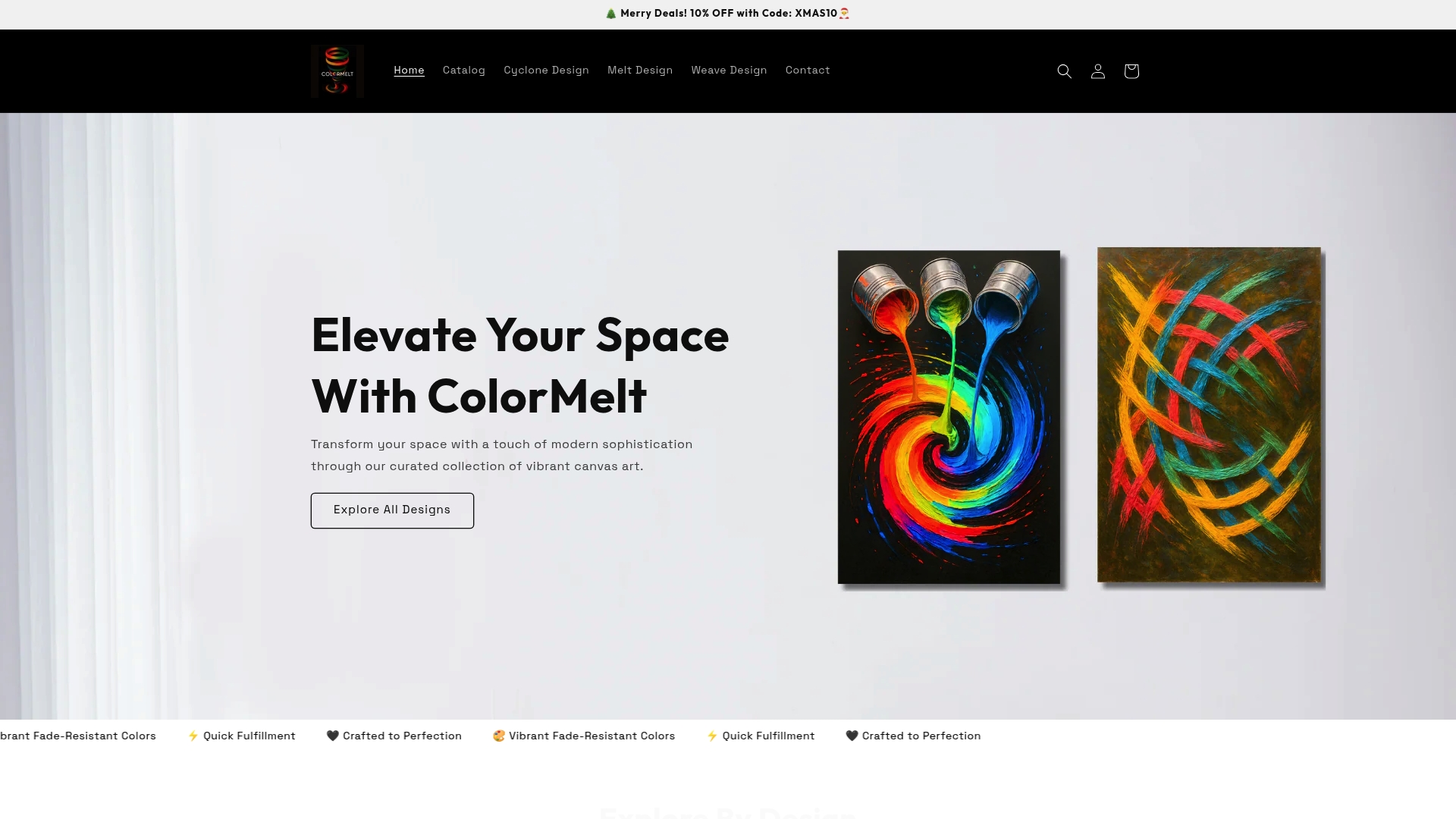
For decorators drawn to the luminous quality of acrylic, Colormelt’s acrylic triptych prints deliver the high-contrast vibrancy that modern and minimalist spaces demand. The triptych format also solves the scale problem: three panels together fill a wall the way a single large piece would, but with added visual rhythm. Browse the full collection to find the print type and design that fits your space.
FAQ
What is the most durable type of decorative print?
Metal prints on aluminum are the most durable option, resisting moisture, scratches, and fading in high-traffic or humidity-prone spaces. Acrylic prints offer comparable durability with a glossier finish.
What type of print works best for a living room?
Canvas prints and giclée reproductions work best in living rooms because their textures add warmth and their formats suit large-scale display. A single large canvas print creates a stronger focal point than several smaller pieces.
How do I choose between canvas and acrylic prints?
Choose canvas for warm, textured spaces with traditional or eclectic decor. Choose acrylic when you want vivid, luminous color in a modern or minimalist room.
What is a giclée print?
A giclée print is a high-resolution inkjet reproduction printed at a minimum 1200 dpi on archival paper or canvas. The format is the preferred choice for fine art reproductions in galleries and private collections.
Are screen prints good for home decor?
Screen prints are well suited for home decor, particularly in modern, eclectic, or industrial spaces. Their layered ink texture and bold graphic quality make them strong statement pieces on paper, fabric, or wood substrates.